Stock MarketCybersecurityAIEarnings
The Patchpocalypse: Why Everything Keeps Breaking, and What It Means for Cybersecurity Stocks
Prefer to listen? This one’s an episode too.
Paycheck Paradox podcast · 12:21
The Patchpocalypse: Why Everything Keeps Breaking, and What It Means for Cyber Stocks
The short version: In one week, Microsoft 365, the FAA, Workday, JPMorgan Chase, United Airlines, the NSA’s classified network and Apple’s iCloud all went down or stumbled. The internet decided it had to be a secret attack. The boring truth is more useful to know. AI is now finding software flaws faster than ever, attackers are using AI to exploit them faster than ever, and so companies and agencies are patching faster and more often than they ever have. When you rush that much change into live systems, more of it breaks. People have started calling it the “Patchpocalypse.” It’s also why cybersecurity stocks just had one of their biggest days of the year, led by Palo Alto Networks, CrowdStrike and Okta.
A Week of Things Breaking
Here’s what went down between November 12 and November 17, and what each organization said caused it.
| Who | When and what broke | The stated cause |
| Microsoft 365 | Outlook, Teams and Copilot, from Thursday, November 12 until early Saturday, about 38 hours | A hidden bug in a fix for its network gateway servers that began rolling out in July, plus a surge in load. Microsoft said it was not related to cyber or AI. |
| FAA | A nationwide ground stop on Friday, November 13, a little over four hours | A newly installed router at a radio site in Arkansas flooded a key communications system. Officials say the root cause isn’t confirmed yet. |
| Workday | Employees at client companies locked out, Friday evening into Saturday | A problem found while testing its backup systems |
| JPMorgan Chase | Slow transactions on Monday, November 16, which also hit people at other banks dealing with Chase | A software bug in on-premise hardware. Chase said there’s no evidence it was cyber-related. |
| United Airlines | A departure system outage Monday evening, about 150 flights delayed | No cause given; no sign of a cyberattack |
| NSA | Its internal classified network degraded on Tuesday, November 17 | “Scheduled routine maintenance,” per the NSA. The Director of National Intelligence said it was patching after a PHP vulnerability was found. |
| Apple | iCloud sign-in and the App Store, about six hours on Tuesday | An “internal update.” Apple said it wasn’t a cyberattack. |
Look at the right-hand column. Three of the biggest (Microsoft, the NSA and Apple) trace back to an update or a patch. The FAA’s problem came from new equipment being installed. Chase and Workday point to software bugs and testing. None of them points to an intruder. Director of National Intelligence Jay Clayton told Congress on Wednesday that these were separate outages tied to maintenance and technical changes, not a coordinated or state-sponsored attack. Secretary of State Marco Rubio put it more bluntly: “We are not under systemic attack.”
The Conspiracy Crowd Will Do What It Does Best
Seven big outages in six days is a pattern that begs for a story, and the internet supplied plenty: a foreign power testing the grid, a cover-up of a massive hack, a dry run for something worse. Even a few senators joined in. Sen. Josh Hawley called it “the greatest coincidence in the history of the world” if it’s really a coincidence, while admitting he had no private information pointing to a link.
Here’s the thing. Conspiracy theories will always be with us, because “a secret enemy did it” is a more satisfying story than “a lot of IT teams were moving too fast.” But this week’s outages weren’t a coincidence and they weren’t a plot either. They have a common cause, and it’s hiding in plain sight. It’s the same reason your phone has been asking you to install updates more often than it used to.
The outages are connected, just not by a villain. They’re connected by speed.
What’s Really Going On: The AI Patch Race
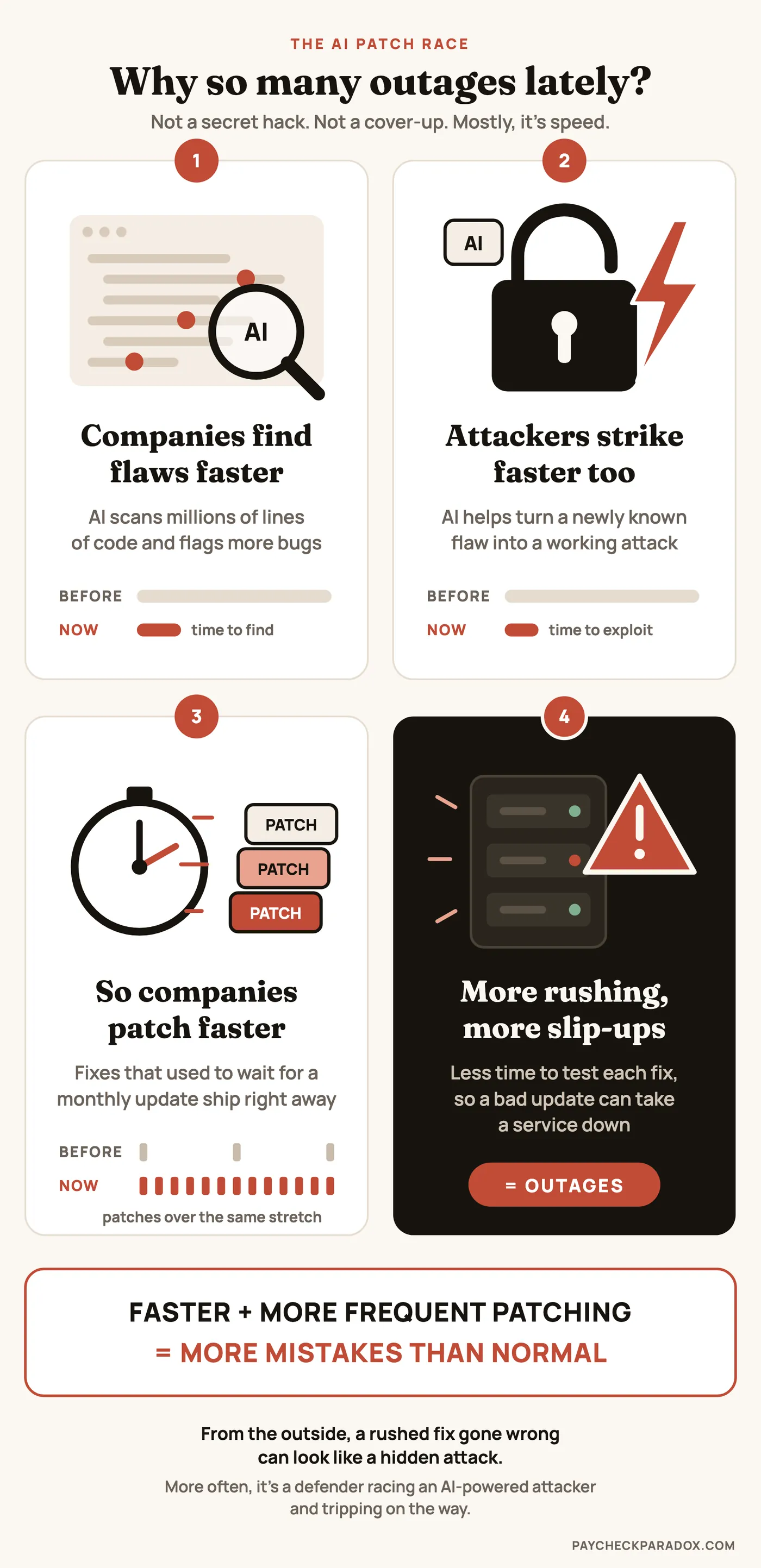
The illustration above shows the whole chain in four steps. Here’s each one with the facts behind it.
1. Companies are using AI to find flaws faster
Since Anthropic released its Claude Mythos Preview model in April, AI tools have been finding software bugs at a pace no human team could match. They read through millions of lines of code and flag weak spots that sat unnoticed for years. The result is a flood. More than 100,000 software vulnerabilities have been publicly disclosed so far in 2026, passing that mark on November 13, which is more than double all of 2025. In July, Microsoft fixed 622 flaws in its products in a single monthly update, roughly triple its previous record. Bank of America brought in about 1,000 contractors just to patch bugs that AI had found.
2. Attackers are using AI to exploit them faster
Every flaw a company finds is a flaw an attacker can find too, and the same AI that writes a fix can help write an attack. The window between “a weakness becomes known” and “someone is actively using it” used to be measured in weeks or months. It’s shrinking fast. On Tuesday, the federal cyber agency CISA told organizations to “immediately patch” a critical flaw in Java, nicknamed Java4Shell, that could let an attacker crash or take over a server without logging in. Java runs inside government agencies and, by one count, about 90% of Fortune 500 companies. There’s no evidence anyone has used it yet, and nobody wants to be first to find out.
3. So everyone is patching faster
Put steps 1 and 2 together and the pressure is obvious. Fixes that used to wait for a monthly update now ship right away. Sen. Mark Warner described it as enormous pressure to patch immediately, often all at once, and called this week a “wake-up call.” The White House’s National Cyber Director, Sean Cairncross, said the disruptions come from updating and modernizing old systems, and added, “I’d expect to see more of it.”
4. Faster plus more frequent patching means more mistakes than normal
A patch is a change to a live system, and every change carries a little risk. Normally that risk gets managed with time: test the fix in a copy of the system, roll it out to a few machines, watch, then roll it out everywhere. When you have to ship ten times as many fixes in a fraction of the time, some of that testing gets squeezed. Most patches still go in cleanly. But multiply a small failure rate by a huge number of changes, and you get exactly the kind of week we just had. Microsoft’s outage is the textbook example: a fix rolled out in July carried a hidden bug that only blew up months later under heavy load.
That’s the Patchpocalypse in one sentence: FASTER + MORE FREQUENT PATCHING = MORE MISTAKES THAN NORMAL.
Will It Get Better?
Probably, though not right away. There are early signs the flood can be managed. Linux creator Linus Torvalds has said the wave of AI-found bugs in the Linux kernel may have peaked, and on at least one big open-source project, AI-assisted fixes are now arriving faster than new bug reports. The same AI that finds the holes is starting to help write and test the patches. For the next few months, though, expect more “mysterious” outages, more urgent update prompts on your phone and laptop, and more people insisting it’s all a cover-up.
What you can do: keep your own devices updated (most consumer updates are well tested before they reach you), keep a little cash and a backup way to pay on hand in case your bank’s app hiccups, and don’t panic-sell because a website went down for a few hours.
Where Cybersecurity Stocks Come In
If patching faster is the problem, the cybersecurity industry sells a big part of the fix. Not because it stops companies from patching, but because it buys them time to patch safely. Here’s how the main players help:
- Shielding a flaw before it’s fixed. Firewalls and network security from companies like Palo Alto Networks and Fortinet can recognize and block attacks aimed at a known flaw, a trick sometimes called “virtual patching.” That lets an IT team test the real fix properly instead of rushing it out tonight.
- Catching the attack in progress. Tools like CrowdStrike’s watch computers and servers for the telltale behavior of an exploit and stop it, even if the hole hasn’t been patched yet.
- Making stolen access less useful. Identity companies like Okta control who can log in to what. If an attacker gets a foothold, strong identity controls limit how far they can go.
- Deciding what to fix first. With 100,000-plus flaws a year, the real skill is sorting the five that matter this week from the thousands that can wait. More and more security platforms use AI to do exactly that.
In other words, the more flaws AI finds, the more companies need help defending the gap between “we know about it” and “we fixed it.” That’s the core of the bull case, and on Wednesday the market leaned into it hard.
Wednesday’s Huge Move
Cybersecurity stocks surged on November 18, first on the CISA Java warning and the week of outages, then again after the market closed when Palo Alto Networks reported earnings.
| Stock | Regular session, Nov 18 | After hours |
| Palo Alto Networks (PANW) | Up sharply, about 6% by midday (some reports put the gain near 10%) | Up about another 7% to 8% on earnings and a $4.5 billion acquisition, to around $365 |
| Okta (OKTA) | Up about 11% to 12%, the biggest gain of the group | Higher in sympathy with Palo Alto |
| CrowdStrike (CRWD) | Up about 8% to 9% | Higher in sympathy with Palo Alto |
| Fortinet (FTNT) | Up about 6% | |
| Cloudflare (NET) | Up about 6% | |
| Global X Cybersecurity ETF (BUG) | Up about 6% by midday |
Figures vary a little by source and by time of day; after-hours trading is thin and can swing a lot before the next morning’s open.
Palo Alto’s quarter, in plain numbers
Palo Alto reported its fiscal first quarter (August through October) after the close, and it was strong almost everywhere:
- Revenue of $3.44 billion, up 39% from a year ago, against about $3.31 billion expected.
- Adjusted earnings of $1.05 a share, against about $0.97 expected and $0.93 a year ago.
- Next-Generation Security annual recurring revenue, its fastest-growing business (cloud, AI and platform subscriptions), reached $9.73 billion, up 66%.
- Remaining performance obligations, the contracted revenue it hasn’t booked yet, hit $21 billion, up 35%.
- Adjusted free cash flow of $1.9 billion in the quarter.
- Guidance raised: full-year revenue is now expected at $14.52 billion to $14.57 billion, up from $14.1 billion to $14.2 billion, and adjusted earnings at $4.26 to $4.30 a share, up from $4.16 to $4.19.
The finance chief, Dipak Golechha, tied the raise directly to the threat environment and the demand the company sees ahead. One number worth noticing in the other direction: operating income under standard accounting (GAAP) fell to $96 million from $309 million a year earlier, even as the adjusted figure rose. The difference is costs the adjusted number leaves out, like stock-based pay, and it’s worth watching.
The acquisition: Applied Compute
Palo Alto also agreed to buy Applied Compute for about $4.5 billion, paid entirely in Palo Alto stock. Applied Compute builds technology that helps companies train and run “open-weight” AI models (models a company can download and adapt to its own data, rather than renting through someone else’s service). It was reportedly valued at $3.25 billion after a recent $350 million fundraising round backed by Nvidia, Blackstone, Kleiner Perkins and Lux Capital. Its CEO, Yash Patil, will become Palo Alto’s co-chief AI officer. The deal is expected to close in Palo Alto’s fiscal third quarter, roughly February to April 2027.
The logic, in CEO Nikesh Arora’s words: “Every enterprise is going to run a mix of open and closed models, and every one of those models needs to be secured.” Palo Alto wants to be the company that helps businesses build and run their own AI safely, not just the company that guards the network around it.
The Case for Cybersecurity Stocks
- Demand that doesn’t depend on the economy. Companies can delay a new office or a hiring plan. They can’t delay patching a flaw the government told them to fix immediately. Security budgets tend to hold up even when other spending gets cut.
- AI makes the problem bigger, which makes the market bigger. More code, more AI models and more AI-found flaws all mean more to defend. Palo Alto’s 66% growth in its newer subscriptions shows customers are spending on exactly that.
- Recurring revenue. Most of this industry sells subscriptions, and contracted revenue like Palo Alto’s $21 billion backlog gives good visibility into the next few years.
- Consolidation favors the big platforms. Stretched IT teams want fewer tools, not more. That tends to help the large platforms (Palo Alto, CrowdStrike, Fortinet) that can do many jobs from one dashboard.
- Policy tailwinds. Congress is holding hearings on this week’s outages, and outages plus urgent government warnings tend to turn into rules and budgets for better security.
The Risks, and They’re Real
- Valuations are high. Even before this week, Palo Alto traded at roughly 85 to 90 times next year’s expected earnings, versus about 57 times on average over the last five years. Stocks priced for perfection fall hard on a merely good quarter.
- Buying with stock dilutes shareholders. Paying $4.5 billion in stock means more shares, and Palo Alto’s share count was already expected to grow about 10% this year from earlier deals. That’s a big reason analysts expected earnings per share to grow far slower than revenue.
- AI can cut both ways. These stocks dropped sharply in February when Anthropic introduced an AI security tool, on fears that AI could do some of what security vendors charge for. That risk hasn’t gone away.
- Security software is software too. In July 2024, a single faulty CrowdStrike update crashed millions of Windows computers around the world, grounding flights and taking hospitals and banks offline. The companies that help others patch safely must patch their own products safely too, and a mistake there can be the biggest outage of all.
- Headline rallies fade. Big one-day jumps on scary news often give back part of the gain once the news cycle moves on. If the patch wave peaks, as Torvalds suggests it might, some of the urgency premium could leak out of these stocks.
- The broader market still matters. With the Fed raising rates again, high-priced growth stocks are the first to get hit when bond yields jump.
How We’d Think About It
This isn’t advice, and nobody should chase a stock that just jumped 10% in a day. But the Patchpocalypse is a real, multi-year trend, not a one-week story. If you want exposure, a few ideas to weigh:
- Consider a basket rather than one name. A cybersecurity fund spreads the bet across many companies, so one bad update or one bad quarter doesn’t sink you.
- Buy in steps, not all at once. After a jump like Wednesday’s, adding a little at a time lets you take advantage of pullbacks instead of fearing them.
- Watch the next reports. CrowdStrike and Okta usually report in early December. If their numbers echo Palo Alto’s, the trend is confirmed. Our Market Calendar tracks the dates.
- Keep it a slice, not the whole pie. Even a great trend can be a bad investment at the wrong price.
The Bottom Line
The recent outages weren’t a cover-up, a foreign attack or a cosmic coincidence. They were the side effect of an arms race: AI finds the holes faster, AI exploits them faster, and everyone patches faster to keep up, which means more patches go wrong. Conspiracy theorists will keep doing what they do best. The rest of us can recognize the pattern for what it is, keep our own devices updated, and pay attention to the companies whose whole job is to make that race a little less dangerous. Just remember that a great story and a great price aren’t always the same thing.
This article is for information only and isn’t investment advice. Prices and percentage moves are from news reports on November 18, 2026, and can change quickly, especially after hours.
We don't currently earn commissions from links on this site. Nothing here is personalized investment advice; we are not licensed financial advisors. The authors may hold positions in securities we mention and may trade them at any time.