Stock MarketStrategy
The Asymmetry of Loss: Why Recovering in the Stock Market is Harder Than It Looks
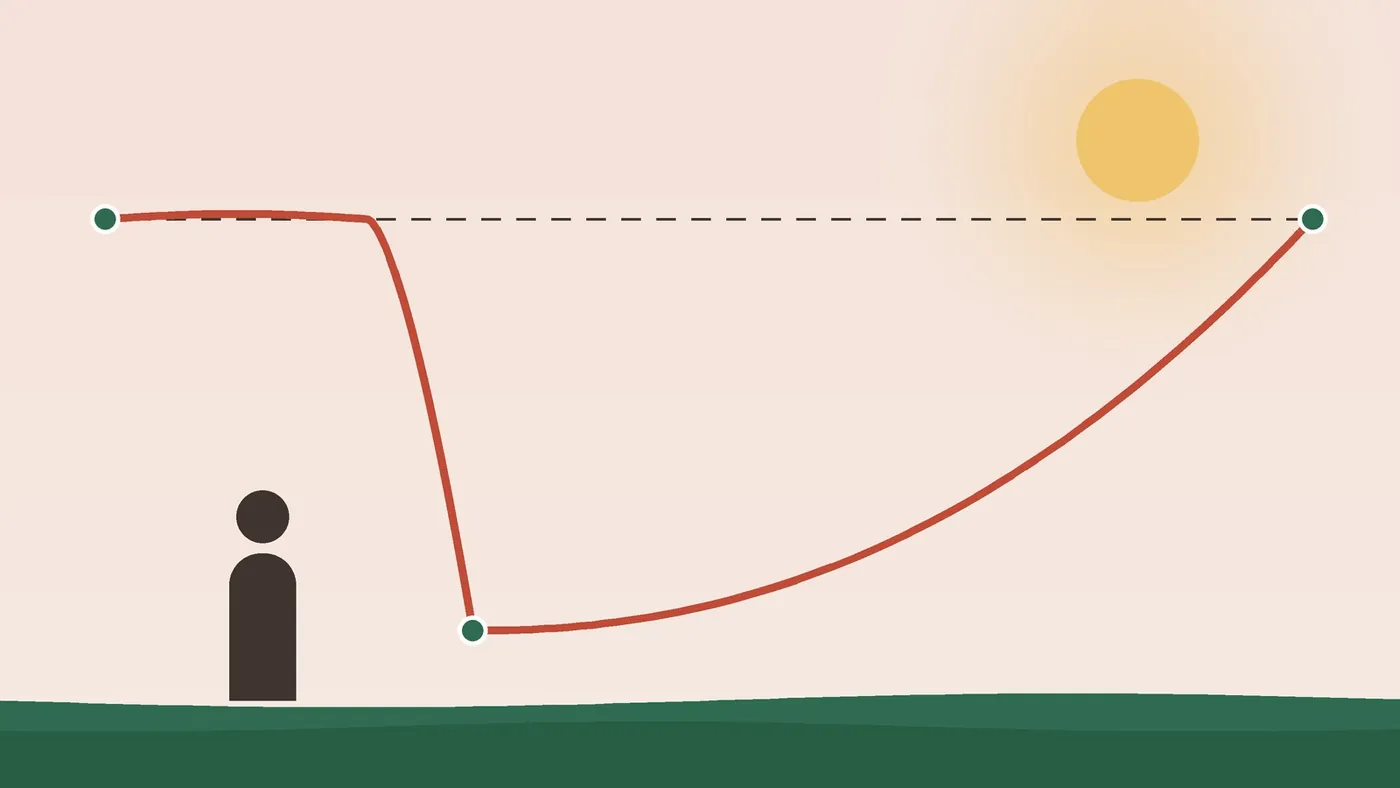
There is a cold, mathematical reality to the stock market that catches many investors off guard: the math of losing is fundamentally different from the math of winning. When a portfolio drops, the percentage gain required just to get back to breakeven is always larger than the percentage that was lost.
This asymmetry is one of the most compelling arguments for active risk management, protecting unrealized gains, and knowing when to take money off the table.
The Math Behind the Trap
The misconception stems from how we naturally process percentages. If a stock drops 20%, it is human nature to assume it simply needs a 20% rally to make you whole. But percentages are calculated based on the starting value, and a loss shrinks your starting base.
Consider a portfolio sitting at $1,000,000. If the market takes a 20% correction, the portfolio sheds $200,000 in value, leaving a balance of $800,000.
To recover that lost $200,000, your new base of $800,000 has to work significantly harder. A 20% gain on $800,000 would only generate $160,000, leaving you short of the original balance. To get back to the initial $1,000,000, that $800,000 balance must actually grow by 25%.
As the losses deepen, the recovery curve goes from steep to nearly impossible:
| Portfolio Decline | Required Gain to Breakeven |
|---|---|
| 10% | 11.1% |
| 20% | 25.0% |
| 30% | 42.9% |
| 40% | 66.7% |
| 50% | 100.0% |
| 75% | 300.0% |
A 50% drawdown requires a 100% return—a doubling of your money—just to get back to the starting line.
The Danger of Watching Unrealized Gains Evaporate
This mathematical reality highlights the severe danger of round-tripping a trade—watching a massive unrealized gain turn into a steep loss.
When you sit on substantial unrealized gains in a momentum stock or a tech ETF, you have expanded your capital base. If you allow that inflated base to collapse, you are not just losing “house money.” You are subjecting your capital to the asymmetric math of recovery. If a stock doubles and then drops 50%, you haven’t broken even on the ride down; you’ve wiped out the entire gain, and your capital is now working from a compressed base to climb back up.
Protecting these gains is critical to long-term wealth compounding. Preventing deep drawdowns ensures that your capital is always working on growing your net worth, rather than simply digging out of a hole.
Strategic Defense: Taking Money Off the Table
The most effective way to combat the asymmetry of loss is to lock in profits. Scaling out of a winning position—selling a quarter or a half of your shares into strength—removes risk and secures a portion of the expanded capital base.
This defensive maneuver does come with friction, primarily in the form of capital gains taxes. Taking profits in a taxable brokerage account triggers a tax event, which is why some investors hesitate to sell, preferring to ride out volatility to avoid the tax bill.
However, paying a known tax rate on a secured profit is often vastly superior to watching the profit evaporate entirely in a market correction. Navigating the choice between short-term capital gains (taxed as ordinary income) and long-term capital gains (taxed at favorable rates) requires careful planning based on your income brackets and holding periods. You should obviously consult your tax advisor to optimize this strategy for your specific financial situation.
Ultimately, realizing a gain means the market can no longer take it back. By selectively taking money off the table, you sidestep the brutal math of recovery and ensure your portfolio remains positioned for actual growth.
Next, read: Taking Money Off the Table: A Prudent Strategy for Stock Market Investors.
We don't currently earn commissions from links on this site. Nothing here is personalized investment advice; we are not licensed financial advisors. The authors may hold positions in securities we mention and may trade them at any time.