Stock MarketAISemiconductorsPolitics
The AI Trade in a Democratic Congress: Delayed, Not Derailed
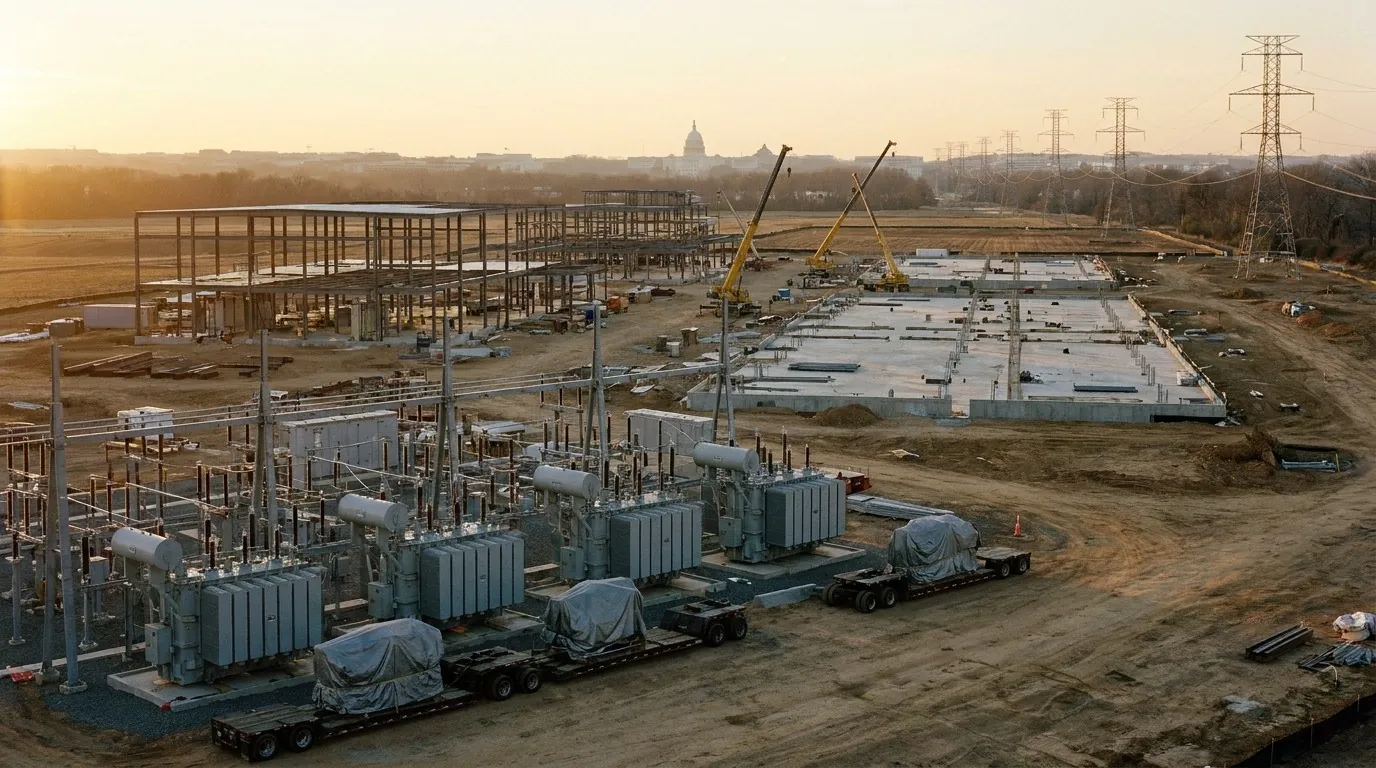
The short version: A Democratic Congress doesn’t kill AI demand. It changes when and where the money can be spent. The AI trade is maturing into a heavy-industry buildout, set by power, permits and equipment. The bigger threat may sit in statehouses and town halls rather than Washington. And a record order book like the one at Dell (DELL) shows how much revenue now depends on buildings being ready on time.
Democrats won both chambers in Tuesday’s midterms, and the U.S. stock market rallied hard on Wednesday. The Dow gained more than 1,400 points during the session. Under that broad rally, the AI trade split in two. Microsoft (MSFT) and Amazon (AMZN) each jumped more than 6%, while NVIDIA (NVDA) and other chip stocks slipped.
That split captures the new question for investors. It’s no longer whether the capital will be spent. It’s exactly when and where it can be deployed. Don’t mistake more oversight for a collapse in demand.
Wednesday’s Split, in Numbers
The selling wasn’t aimed at AI as an idea. It was aimed at the companies that need new data centers to get built, and it spared the ones that already own them.
| Group | Stocks | Approximate move during the session |
| Big AI buyers | Amazon (AMZN), Microsoft (MSFT), Alphabet’s Google (GOOGL) | Up about 6% to 7%, 6% and 3% to 5% |
| Power and cooling equipment | Vertiv (VRT), GE Vernova (GEV), Eaton (ETN) | Down about 9%, 8% to 11.5% and 7% |
| Power producers | Constellation Energy (CEG), Vistra (VST) | Down about 9% and 15% |
| AI cloud operators | CoreWeave (CRWV) | Down about 4% to 9.5% |
| Chips and servers | NVIDIA (NVDA), Super Micro Computer (SMCI) | Down about 1.6% and 3.8% |
| Clean energy | First Solar (FSLR), Enphase Energy (ENPH), NextEra Energy (NEE) | Up about 8.4%, 8.8% and 4.6% |
These are intraday snapshots, not closing prices. Ranges reflect different times of day. Sources: Reuters via Yahoo Finance, CNBC, TIKR and StockTitan.
The logic is scarcity. If new capacity gets harder to build, the capacity already standing is worth more, and the companies that own it gain an edge. As Siebert Financial’s Mark Malek told Reuters, “The AI buildout will become more expensive, not disappear.” The same report says analysts doubt legislation could meaningfully stall construction, though they do expect more hearings and investigations.
The spending itself isn’t slowing. Business Insider’s tally of company guidance puts Amazon, Alphabet, Meta, Microsoft and SpaceX on track for $803 billion to $828 billion in capital spending this year. Amazon and Alphabet have both said they expect to spend more in 2027. But look at Microsoft: it now expects about $170 billion for the calendar year, down from its earlier outlook, because of delays in third-party data center capacity. Demand didn’t fall. The buildings weren’t ready. That’s the whole thesis in one line of guidance.
The Magnificent Seven: One Headline, Different Outcomes
In general, a Democratic Congress means more scrutiny of AI and data centers. The era of lightly regulated infrastructure expansion now faces legislative friction. But that friction won’t hit the Magnificent Seven evenly. Apple (AAPL), Meta (META), Tesla (TSLA) and the rest of the group each have different exposure to infrastructure bottlenecks. The clearest divide is between the companies selling the hardware and the ones buying it:
- The hardware giant: NVIDIA (NVDA). Demand remains robust, but any delay in data center permitting or grid expansion pushes out the timeline for GPU deliveries. If hyperscalers can’t secure power, they defer server orders. That creates near-term revenue friction.
- The hyperscalers: Amazon (AMZN), Google (GOOGL) and Microsoft (MSFT). Their massive balance sheets largely insulate them. They can absorb the cost of grid modernization and afford to fund local power generation that bypasses public utility constraints. Their AI capital spending will still face intense congressional oversight on environmental impact and anti-competitive practices.
Dell: Where a Permit Delay Meets a Purchase Order
If you want to see this risk in one set of numbers, look at Dell (DELL). It sells the finished AI servers that go into these buildings, which puts it right where a slipped construction schedule turns into a slipped sale.
The demand is not in question. In its fiscal second quarter, which ended July 31, Dell booked a record $60.9 billion in AI server orders and finished with a record $95 billion AI backlog. Total revenue hit $47 billion, up 58% from a year earlier, and the company raised its full-year revenue outlook to $192 billion.
The question is timing. One analysis of the quarter shows how far orders have run ahead of shipments:
- Orders vs. shipments: Dell shipped $16.4 billion of AI servers in the quarter, so it took in about $3.71 of new orders for every dollar it delivered.
- What has to ship: Hitting its $74 billion AI server target for the year means converting roughly 44% of that backlog in the second half of the fiscal year.
- Who’s buying: More than 6,500 AI customers, including AI cloud operators, governments and large companies. Dell doesn’t name them or say how concentrated the orders are.
- What it costs to wait: Free cash flow was $986 million against $4.13 billion of net income, a gap the analysis ties to the working capital needed to build the backlog.
For now, Dell says its main limit is component supply, especially memory. Power and permits are a customer-side risk, not the thing holding back shipments today. But customers’ schedules depend on power, permits and financing, and all three just got less certain. A server can’t go live in a building that has no power yet. At this scale, even a small percentage of delayed orders could move billions of dollars from one fiscal period to the next.
That’s a very different problem from canceled orders. A delayed order still shows up as revenue later. It can still hurt a stock in the meantime, because investors pay up for growth on a schedule. Two things soften the risk for Dell. Large companies running AI in their own facilities don’t depend on a contested megacampus. And Dell also sells traditional servers, storage and PCs, so it isn’t a pure AI bet. The most fragile link is the AI cloud operators, which tend to borrow heavily to buy servers and have the least room to wait.
Super Micro Computer (SMCI) and Hewlett Packard Enterprise (HPE) face the same basic question. Dell’s scale just makes the math easiest to see.
What to look for in Dell’s next report, expected in late November (the date isn’t confirmed):
- Backlog and shipments together. A backlog that shrinks because shipments rose is healthy. One that shrinks while shipments stall means orders are going away, and that would challenge this whole thesis.
- The $74 billion target. Any change, and whether management blames supply or customer readiness.
- Margins and cash. Non-GAAP gross margin was 21.1% last quarter, and memory prices have surged. Holding parts for delayed customers would show up in cash flow first.
The AI IPO Test: Anthropic Goes Public
This scrutiny arrives just as a new wave of massive AI startups prepares to seek public capital. The defining test case is Anthropic (ANT), which publicly filed its S-1 on October 26 for what could be a record-breaking IPO.
The filing shows both sides of the AI boom. Anthropic reported $16.3 billion in revenue in the first half of 2026, up from about $1.2 billion a year earlier. It also spent nearly $9 billion on compute and infrastructure in those same six months.
With lawmakers poised to look harder at data center expansion, startups that spend billions on compute may face a public market that’s more skeptical of their capital efficiency. If red tape slows infrastructure deployment, the path to profitability gets steeper for AI startups. That could compress the valuations they can command at IPO.
The Risk Horizon: Three Bottlenecks to Watch
Hyperscalers have the capital to build their own microgrids, but they can’t outspend local legislation or physical supply limits. Watch these three risks over the next 12 to 24 months:
1. The moratorium wave
The most immediate threat to data center expansion is legal, not financial. Pushback over energy and water use has hardened into actual construction pauses and bans.
- Federal: The Artificial Intelligence Data Center Moratorium Act (S. 4214) hasn’t moved past committee. It would have to be reintroduced once the new Congress is seated.
- State: New York lawmakers are weighing a pause of more than three years on new data centers of 20 megawatts or more. A Virginia bill, carried over to 2027, would require local approvals until pending utility requests are met or July 2028, whichever comes first.
- Local: This is where the action is. Data Center Census logged 104 local and state moratorium actions across 26 states as of October 1. SAVRN’s broader tracker, which also counts siting conditions and incentive changes, lists more than 1,200 city and county measures and calls that a floor.
Tuesday made this risk much more concrete, and Congress was only part of it:
- Texas: Democrat Gina Hinojosa defeated Gov. Greg Abbott and wants an immediate statewide moratorium on data centers. Wells Fargo estimates Texas holds 27% of planned U.S. data center capacity. How far a governor could go without state lawmakers is an open question, but this is the single biggest thing to watch.
- Other big states: Democrats also won or kept the governorships of Georgia, Ohio and Pennsylvania, which hold about 7%, 5% and 5% of planned capacity by the same estimate.
- Ballot boxes: Ohio voters decided 21 data center measures in 18 municipalities, and at least 14 towns passed bans or restrictions. Nationally, Stateline reported 33 local measures limiting data centers had passed or were ahead late Tuesday, with only one result going the industry’s way. These counts are early and unofficial.
A patchwork of state and municipal rules will complicate hyperscaler capacity planning and push them to diversify away from traditional tech hubs. A federal bill can be debated for years. A town vote takes effect on a specific site.
2. Transmission gridlock
Generating power is only half the battle. The Department of Energy’s draft 2026 National Transmission Needs Study points to a pressing need for more transmission capacity, with data centers among the main drivers. Connecting to the grid can also outlast an AI deployment cycle. PJM data shows AI infrastructure projects that entered service in 2025 averaged more than seven years to get there. (PJM, the largest U.S. grid operator, says much of that time comes after its own process ends.)
3. Heavy equipment supply chains
Moving from silicon to heavy industry brings heavy-industry bottlenecks. Wood Mackenzie says substation transformer lead times now exceed 160 weeks, or about three years. Commercial generators and advanced liquid cooling add their own constraints. Even a fully permitted, fully funded project can sit waiting to switch on.
The Silicon Divergence: Not All Chips Are Equal
Does a bottleneck in power and permits mean less demand for AI hardware across the board? In the short term, it delays deployment rather than canceling orders. But it hits the chip supply chain unevenly.
- Most exposed: compute, servers and memory. High-bandwidth memory from makers like Micron (MU) is physically tied to GPU deployment. If a hyperscaler delays a server order from a company like Dell (DELL) while it waits on a grid upgrade, the GPU and memory orders inside that server move into future quarters too.
- The potential winner: networking. The same constraints are a tailwind here. If hyperscalers can’t get permits for massive central campuses, they’ll build smaller clusters wherever power is available. Making those sites act like one giant AI supercomputer takes a lot of ultra-fast optical interconnect. That’s the business of companies like Broadcom (AVGO), Marvell (MRVL), Arista Networks (ANET), Coherent (COHR) and Lumentum (LITE).
This is the pick-and-shovel idea in action: when a trend hits a wall, look at what it needs to get around it.
The Legislative Playbook and the Nuclear Bypass
We expect a unified Democratic Congress to focus on protecting consumers from AI’s power draw while subsidizing the grid upgrades needed to handle it. Laws that stop utilities from passing the cost of new substations on to residential customers could force data centers to become small utilities of their own.
To get around an overburdened grid and avoid that red tape, Big Tech is already funding dedicated nuclear power in three ways:
- Restarting closed plants through long-term power deals. Microsoft (MSFT) with Constellation Energy (CEG) at Three Mile Island, and Google (GOOGL) with NextEra Energy (NEE) at Duane Arnold in Iowa.
- Building next to existing plants. Amazon (AMZN) bought a data center campus beside the Susquehanna nuclear plant from Talen Energy (TLN).
- Financing small modular reactors. Google’s deal with Kairos Power and Amazon’s with X-energy back first-of-a-kind reactor fleets.
What to Watch Next
- Dell’s report in late November: the first big read on whether backlog is still turning into shipments on schedule.
- Texas: whether Hinojosa’s moratorium becomes a bill or an order, and whether it covers projects already underway.
- The new Congress in January: whether S. 4214 comes back, and which committees schedule hearings on power bills and data centers.
- Early-2027 earnings from the big buyers: firm 2027 spending numbers, and how often “capacity delays” comes up as the reason for a change.
- Equipment orders: whether Vertiv (VRT), GE Vernova (GEV) and Eaton (ETN) report customers pushing out delivery dates.
What would prove us wrong: real cancellations rather than delays, big buyers cutting spending plans for lack of demand rather than lack of capacity, or a statewide moratorium in a major market that actually stops projects already permitted. Any of those would turn “delayed” into “derailed.”
The Bottom Line
The market’s first reaction to AI infrastructure confuses timeline with demand. Red tape may delay the hardware, but the energy the buildout requires isn’t going away. Investors who mistake a delayed regulatory timeline for canceled data center orders may simply be handing their shares to institutions buying the dip.
We follow this closely: see Moves That Matter for the news, updated hourly, On Our Radar for the stocks we’re watching, and our trades, updated hourly, for what we actually do about it.
Companies named are examples, not recommendations. Some of them appear in our trade log. Nothing here is investment advice.
We don't currently earn commissions from links on this site. Nothing here is personalized investment advice; we are not licensed financial advisors. The authors may hold positions in securities we mention and may trade them at any time.