Real EstateMortgageFirst-time buyersInvesting
Pay Off Your Mortgage Early or Invest? A First-Time Homeowner’s Guide

You just got the keys. The boxes are half unpacked, and the first mortgage statement shows a number that makes your stomach drop: over 30 years, you’ll pay more in interest than you borrowed. So the question comes fast, usually from a well-meaning relative: should you throw every spare dollar at the mortgage and be free of it sooner?
It’s a great question, and there’s no single right answer. But there is a clear way to think it through, and a few numbers that settle most of it. This guide walks you through them in plain language, then runs a real example in our free calculator so you can see exactly how it plays out.
The two choices, in plain English
Say you have some extra money each month after your bills: $300, for example, plus a $2,000 bonus or tax refund once a year. You can do one of two things with it:
- Pay off the mortgage early. The extra goes straight to your loan’s principal. You owe less, pay less interest, and own the house outright years sooner. After that, the whole payment is free to invest.
- Invest the extra instead. You keep paying the normal mortgage payment, and put the extra into investments, such as a low-cost stock index fund, where it can grow for decades.
Either way, the same money leaves your checking account. The only question is where it ends up working for you.
The one number that matters most: your mortgage rate
Every extra dollar you put on your mortgage “earns” exactly your mortgage rate, because that’s the interest you no longer pay. If your rate is 6.5%, paying extra is like a guaranteed 6.5% return. No market crashes, no surprises.
Investing in the stock market has historically returned about 10% a year on average over long periods. But that average hides real swings: some years are up 25%, some are down 20% or more. So the honest comparison is:
- Paying off early: a smaller, certain return (your mortgage rate).
- Investing: a bigger, uncertain return (what the market gives you, after taxes).
The lower your mortgage rate, the more investing tends to win. The higher it is, the closer the race gets. If you want to understand why the swings matter so much, our piece on why recovering from losses is harder than it looks is a good primer.
Inflation quietly helps the borrower
Here’s the part most first-time owners never hear about. Your mortgage payment is fixed for 30 years, but the dollars you pay it with lose value every year to inflation. At 3% inflation, a $3,160 payment in year 30 feels like about $1,302 in today’s money. Your paycheck usually rises over time; your mortgage payment doesn’t.
That means a 6.5% mortgage really costs you only about 3.4% a year after inflation. Paying it off early gives up that slowly-shrinking, fixed-rate debt. Investing keeps it, and lets your money grow on top. That’s why our calculator shows every result both in future dollars and in today’s dollars, so you’re comparing real buying power, not just big numbers.
A real example: Sam and Jordan’s first home
Sam and Jordan just bought their first house. Here’s their situation:
- Mortgage: $500,000 at 6.5%, 30 years
- Payment: $3,160 a month (principal and interest)
- Extra money: $300 a month, plus a $2,000 bonus once a year
- Assumptions: 10% average investment return, 3% inflation, 15% tax on investment gains
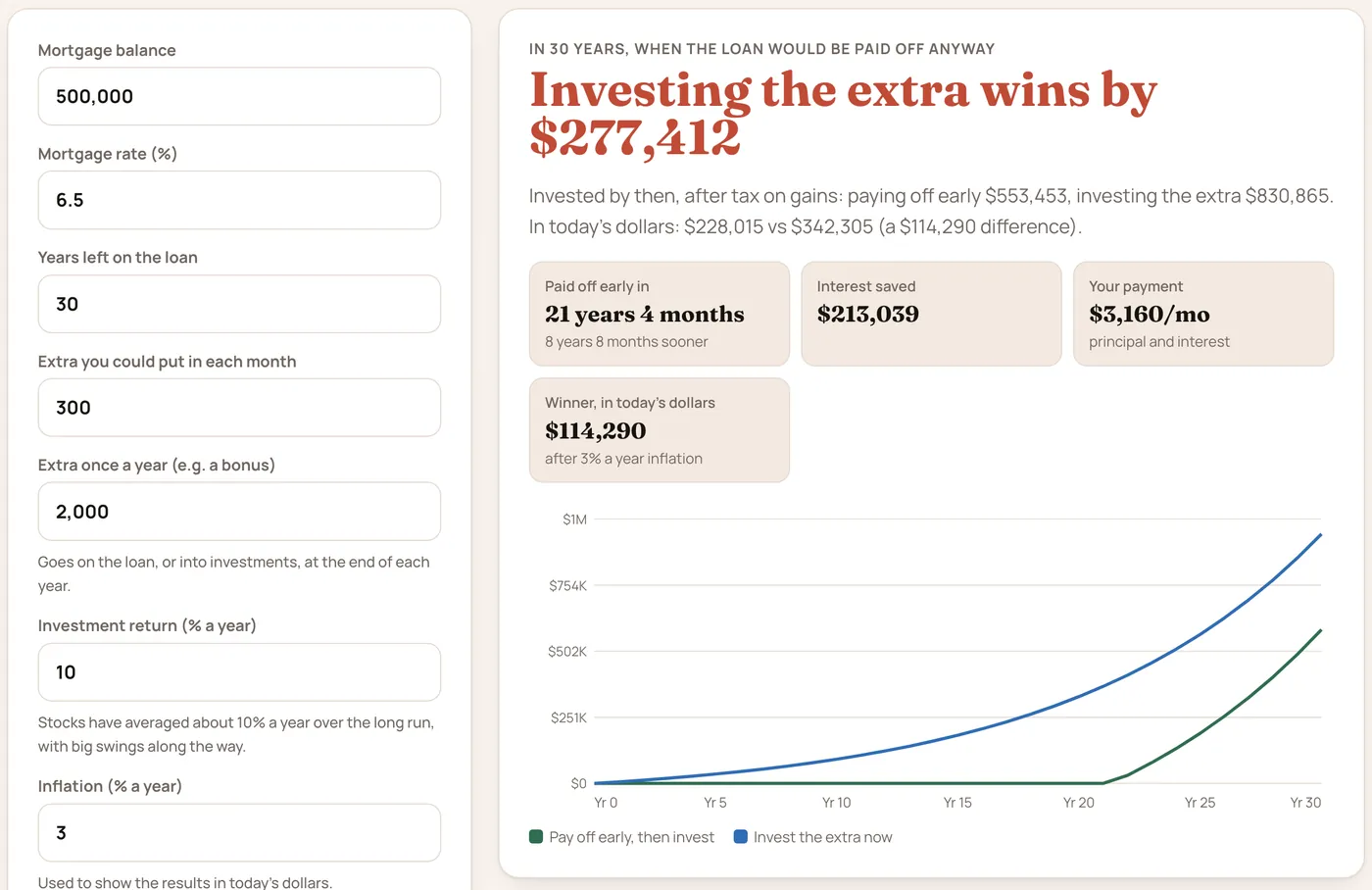
We plugged exactly those numbers into our Pay Off the Mortgage or Invest? calculator. Here’s the real result:
What it tells them:
- If they pay off early, the house is theirs in 21 years and 4 months instead of 30, almost 9 years sooner, and they save $213,039 in interest. Then they invest the full payment plus the extras for the last 9 years.
- If they invest the extra instead, they’d have about $277,000 more when the loan would have ended anyway, after tax on gains. In today’s dollars, that’s about $114,000 more.
So with a 10% return, investing wins clearly, mostly because their money gets decades longer to compound. (Our Compound Growth calculator shows how dramatic that effect gets.)
But change one assumption…
Now drop the investment return to 6%, below their mortgage rate. Same couple, same money. This time, paying off early wins, by about $27,000 in today’s dollars. In their case the break-even is around a 7.1% return: above that, investing comes out ahead; below it, paying off early does.
And if they invest through a 401(k) or IRA, where gains aren’t taxed along the way (set the tax field to 0%), investing wins by even more: about $363,000 in future dollars.
That’s the real lesson: the answer depends on your rate, your expected return, and how much uncertainty you can live with. Which is exactly why it’s worth running your own numbers.
Before you do either: the beginner’s checklist
For most first-time owners, the order of operations matters more than the pay-off-or-invest choice itself:
- Build an emergency fund first. Money in your house isn’t there when the water heater dies or a job ends; you can’t easily get it back out. Aim for three to six months of expenses. Our Emergency Fund calculator gives you a target.
- Grab any employer 401(k) match. A match is an instant 50% to 100% return. Nothing on this list beats it.
- Pay off high-interest debt. Credit cards at 20% or more come before any extra mortgage payment or investing.
- Consider removing PMI. If you put less than 20% down, extra principal that gets you to 20% equity can cancel private mortgage insurance, which is often a great guaranteed return.
- Then decide: extra principal, investing, or a split.
Beyond the math
Numbers aren’t everything. A paid-off home means lower bills in retirement and real peace of mind, and some people simply sleep better without a mortgage. On the other side, invested money stays flexible: you can use it for an opportunity, an emergency, or to make your paycheck optional sooner.
The biggest mistake isn’t choosing the “wrong” side. It’s letting fear of a market drop keep you out entirely. We cover that trap in Stock Market Bubble: Why Fear of the Pop Is Costing You a Fortune. And if you do invest, how you manage gains over time matters too; see The Power of Reusing Capital and Taking Money Off the Table.
Plenty of homeowners split the difference: some extra to principal for the certainty, the rest invested for the growth. The calculator lets you test that too. Just enter the part you’d put on the loan.
Run your own numbers, then keep them
Open the Pay Off the Mortgage or Invest? calculator, enter your balance, rate, years left and the extra you could set aside each month and each year. Change the expected return from the 10% default if you want to be more conservative, and set inflation to what you expect.
With a free account you can save the calculation, come back and revise it when your rate, income or plans change, and share a read-only snapshot with a link. You can also invite a family member so you both see and edit the same saved calculations, handy when you’re planning with a partner. It works the same in the Paycheck Paradox app.
Want the bigger picture? See why “affordable” isn’t the same as smart, check how much house fits after investing first with the Invest-First Home Budget calculator, and find out when your paycheck could become optional with the Freedom Date calculator.
This article is for education only and isn’t financial, tax or investment advice. Investment returns aren’t guaranteed and can be negative. The examples use simple steady-return assumptions and exclude the mortgage interest deduction. Talk to a qualified professional about your own situation.
We don't currently earn commissions from links on this site. Nothing here is personalized investment advice; we are not licensed financial advisors. The authors may hold positions in securities we mention and may trade them at any time.