Stock MarketPoliticsAIBanking
What a Democratic Congress Means for 127 Stocks, From Tailwinds to Direct Targets
Prefer to listen? This one’s an episode too.
Paycheck Paradox podcast · 12:44
What a Democratic Congress Means for Your Stocks
The short version: Democrats take both chambers of Congress in January, but President Trump keeps the veto pen. That combination rarely produces big new laws. What it produces is budget leverage, investigations and the power to block. We sorted 127 stocks by how much those three tools can actually reach them. About a third of the list is largely insulated. The real exposure sits in a few places: the AI and data center buildout, consumer lending and crypto, and the healthcare and clean energy companies that depend on federal money.
This isn’t a prediction about who should win elections, and it isn’t a list of stocks to buy or sell. It’s a map of where Washington’s new balance of power touches a company’s revenue, and where it doesn’t. We’ve tried to separate what Congress can actually do from what makes for a good headline, because the market often confuses the two in the first week.
What Actually Changed, and What Didn’t
Democrats won both chambers in the November 3 midterms. Early AP tallies put them at about 54 Senate seats, with some House and Senate races still being counted. The new Congress is seated in January 2027. Until then, the current Congress still runs things, including a lame-duck session and a funding deadline expected in December.
The single most important fact for investors: Democrats don’t have enough votes to override a veto. That sets the limits on almost everything below.
| What a Democratic Congress can do | What it can’t do on its own |
| Write the budget. Every spending bill has to pass both chambers, so Democrats can trade, delay or shrink money the White House wants. | Pass laws over a veto. Anything the President opposes needs two-thirds of both chambers. |
| Investigate. Committee chairs get subpoena power, staff and the hearing calendar. | Run the agencies. The Justice Department, the FTC, the SEC and the Commerce Department still answer to the White House. |
| Block. No more party-line tax and spending bills like the 2025 law, and the Senate can slow or reject nominees. | Cancel signed contracts or claw back money that has already been appropriated for future years. |
| Find common ground with the President on issues where they already agree. | Restrict drilling, mining or building by itself; those rules mostly sit with agencies, states and towns. |
That last row on the left matters more than it looks. On a few issues, the President and congressional Democrats already want the same thing. A 10% cap on credit card interest rates is the clearest example, and it’s why consumer lenders sit in the most exposed group on this list.
What History Says About This Exact Setup
The combination we’re heading into, a Democratic Congress with a Republican President, has happened before: 22 years since 1928. That includes Eisenhower’s last six years (1955 to 1960), the Nixon and Ford years (1969 to 1976), the end of Reagan’s second term and all of George H.W. Bush’s (1987 to 1992), and George W. Bush’s last two years (2007 to 2008). Three times, the switch came at a midterm exactly like this one: after the 1954, 1986 and 2006 elections.
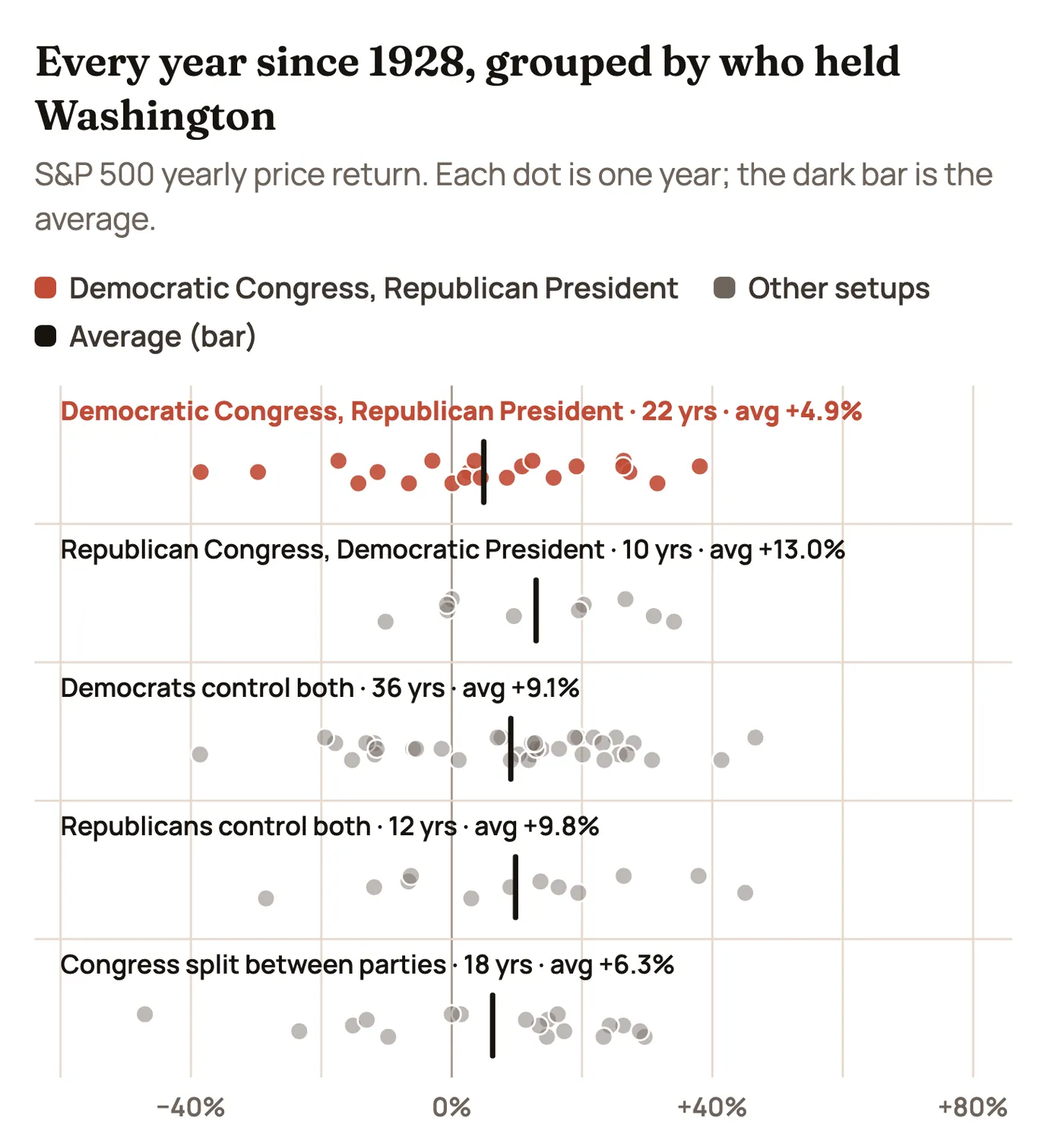
The chart below puts every year since 1928 into one of five groups by who held Washington. Each dot is one year’s price return; the dark bar is the group’s average.
| Who held Washington | Years | S&P 500 average | S&P 500 median | Up years |
| Democratic Congress, Republican President | 22 | +4.9% | +4.0% | 15 of 22 |
| Republican Congress, Democratic President | 10 | +13.0% | +14.5% | 6 of 10 |
| Democrats control both | 36 | +9.1% | +12.4% | 25 of 36 |
| Republicans control both | 12 | +9.8% | +11.3% | 8 of 12 |
| Congress split between parties | 18 | +6.3% | +14.0% | 12 of 18 |
| All years, 1928 to 2025 | 98 | +8.1% | +11.6% | 66 of 98 |
Yearly S&P 500 price returns, without dividends. Each year is assigned by who held the White House and each chamber for most of the year. In 2001 and 2002 the Senate changed hands mid-year, so we count those as split.
On the surface, this setup has the weakest record of the five. Before reading too much into that, look at which years are in it. It includes 1973 and 1974, the oil embargo and one of the worst bear markets of the century, and 2008, the financial crisis. Those three years alone pull the average down by about five points. Take them out and the other 19 years averaged a little over 10%. The market also rose in 15 of the 22 years, about the same hit rate as every other setup.
Here’s what happened in the first two years after each of the three midterm switches:
| After the midterm of | Years | S&P 500 | Dow | Nasdaq |
| 1954 (Eisenhower) | 1955 to 1956 | +29.7% | +23.5% | Not yet created |
| 1986 (Reagan) | 1987 to 1988 | +14.7% | +14.4% | +9.3% |
| 2006 (George W. Bush) | 2007 to 2008 | −36.3% | −29.6% | −34.7% |
Two-year price change. 1987 includes the October crash; 2008 includes the financial crisis.
Three cases, three completely different outcomes. That’s the honest answer: the party mix in Washington didn’t decide any of them. The economy, interest rates, oil and credit did.
A projection, and why to hold it loosely
If you want a number anyway, here’s what history implies for 2027 and 2028, the two years this Congress will sit. The chart starts with $10,000 at the end of 2026 and grows it at this setup’s historical average, at the average of all years, and along the actual paths after the three past switches. The shaded area is the full range of every two-year stretch this setup has produced.
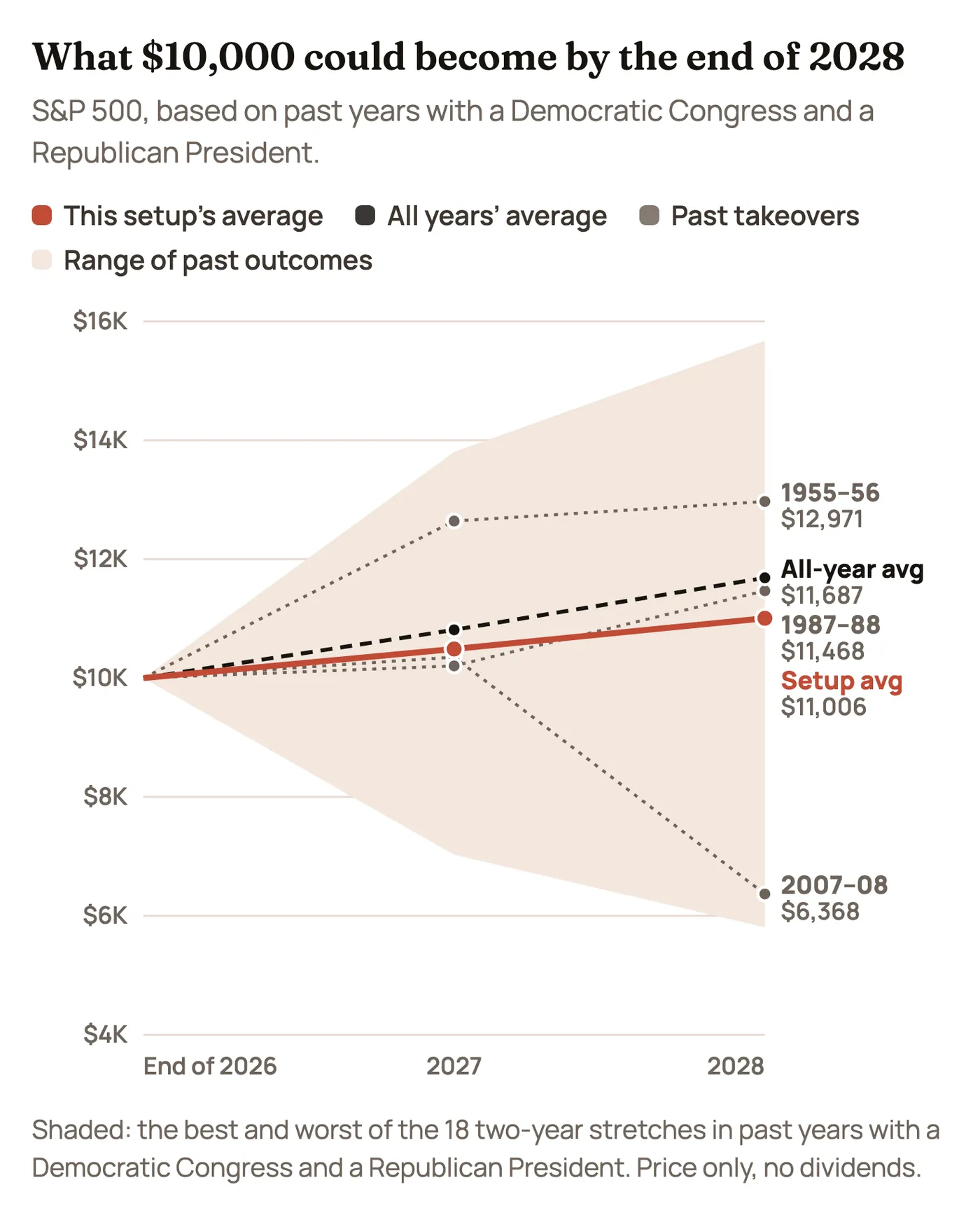
| $10,000 at the end of 2026, if returns match… | End of 2027 | End of 2028 |
| This setup’s average (S&P 500, +4.9% a year) | $10,491 | $11,006 |
| The average of all years (S&P 500, +8.1% a year) | $10,811 | $11,687 |
| The worst two years of this setup (1973 to 1974) | $8,263 | $5,807 |
| The best two years of this setup (1975 to 1976) | $13,155 | $15,674 |
The gap between the two averages is about $700 on $10,000 over two years. The gap between the best and worst cases is almost $10,000. That’s the real lesson of the chart: the range swamps the average. No investor should change a long-term plan because of which party holds Congress. The long-run record belongs to people who stayed invested through all of these setups.
One more data point, from a different cut of history: Morgan Stanley’s analysis, cited by CNBC, found the S&P 500 gained an average of 16% in the year after midterms when Democrats controlled both chambers, regardless of the President’s party, compared with 23% when Congress was split. The year after a midterm has historically been a good one in general. Policy usually shifts which stocks lead, not whether the market goes up.
The Map: 127 Stocks in Six Groups
Here’s the whole list at a glance. Each group gets its own section below, with the reasoning, the numbers we could verify and what to watch.
| Group | Stocks | How Washington reaches them |
| Likely beneficiaries | 9 | Congress can block further cuts to programs they depend on. |
| Largely insulated | 41 | Sales depend on customers and the economy, not federal policy. |
| Mixed | 26 | Real oversight risk, offset by bipartisan support or ways around it. |
| Headwind: AI and data center buildout | 33 | Slower permits and power hookups delay their customers’ projects. |
| Direct regulatory targets | 9 | Specific bills or caps aimed at how they make money. |
| Mild headwind | 9 | Hearings and budget pressure, with limited power to change much. |
One pattern stands out before we go group by group: the biggest moves since the election have come from states and towns, not Congress. Texas elected a governor who wants to pause new data centers, and local ballot measures limiting them passed across Ohio and elsewhere. We covered that in detail in The AI Trade in a Democratic Congress. Keep it in mind for the largest group below.
Likely Beneficiaries (9)
These companies gain mainly because a Democratic Congress can say no to further cuts. That’s a defensive benefit. It protects what exists more than it adds anything new.
The charts below show what the market has done with that idea so far. The first compares each stock’s move the day after the election with where it stood by the latest close. The second shows a full year of prices, with the S&P 500 for reference, so you can see how much of the move was the election and how much was already underway.
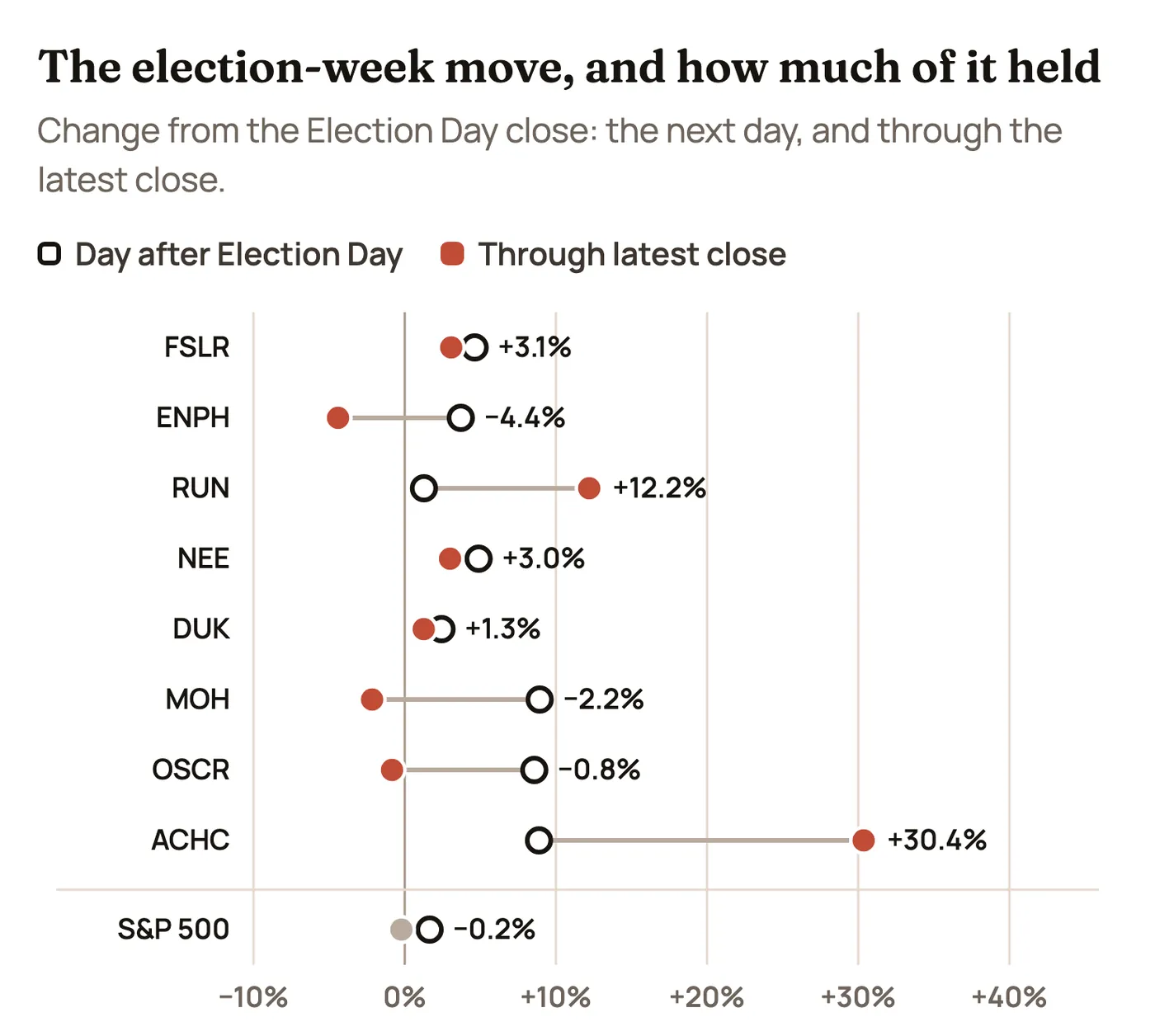
Two things stand out. The healthcare stocks had the biggest first-day pops, with Molina, Oscar and Acadia each closing up about 9%. By the latest close, Molina, Oscar and Enphase had given all of it back and slipped below their Election Day prices. That’s the market saying “hope isn’t policy”: nothing has actually changed yet. Acadia and Sunrun kept climbing, which suggests investors see their exposure as more direct.
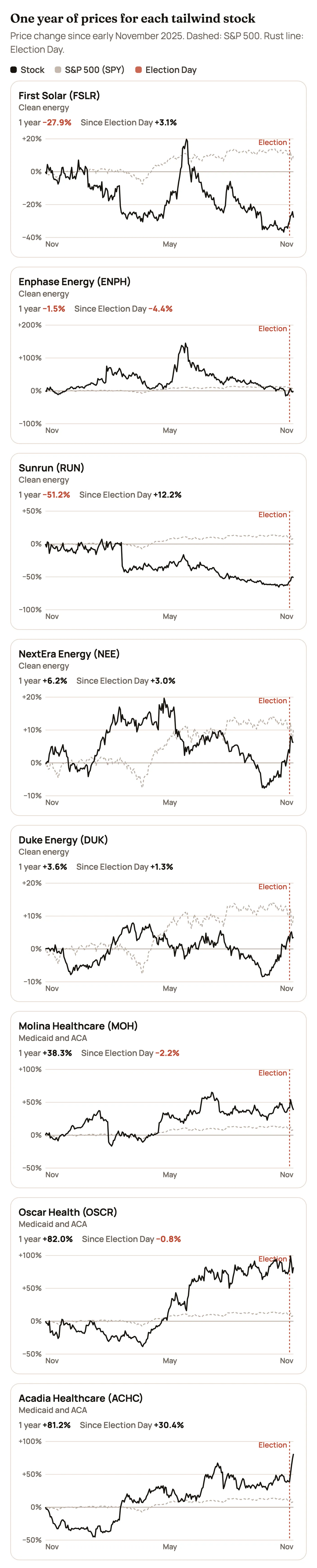
The year view tells a different story than the headlines. Oscar was already up more than 80% in the year before anyone voted, Molina about 40% and Acadia nearly 40%, so the election added to moves that were well underway. (The S&P 500 was up about 10% over the same stretch.) Sunrun and First Solar, the clean energy names most tied to tax credits, are still well below where they were a year ago. The utilities, NextEra and Duke, barely moved at all, which fits their role as steady earners with policy exposure on both sides. Moore Threads isn’t charted: it trades only in Shanghai, outside our price data. Prices are a snapshot through November 9 and aren’t updated hourly.
Clean energy: First Solar (FSLR), Enphase Energy (ENPH), Sunrun (RUN), NextEra Energy (NEE), Duke Energy (DUK)
The 2025 tax law ended key credits for most new solar projects that start operating after 2027, though projects that began construction by July 4, 2026, still qualify. A Democratic Congress can’t easily bring back what was cut, because restoring credits would need the President’s signature. But it can stop another party-line bill from cutting more. That’s why CNBC’s read was that Democrats can block new damage, but probably can’t restore the credits the tax law ended.
The market agreed on day one. First Solar rose as much as 9% during the session and closed up about 5%. Enphase closed up about 4%, NextEra about 5%. The companies aren’t equally exposed, though:
- First Solar makes panels in the U.S. and benefits from the manufacturing credit that survived the 2025 law, plus tariffs that already put foreign competitors at a disadvantage. It’s the most policy-protected of the group.
- Enphase and Sunrun live on home solar, which depends on financing costs and the homeowner credits that already expired. Protection from further cuts helps, but higher interest rates still weigh on demand. Sunrun was still down sharply for the year even after the rally.
- NextEra and Duke are utilities with two engines: renewables and data center power demand. NextEra is also restarting the Duane Arnold nuclear plant in Iowa to supply Google. If data center growth slows, the second engine slows with it, which is why these two are less clean a “win” than the solar names.
Watch: tax credit fights in any budget or tax deal. Because Democrats can block but not easily pass, the realistic upside is a stalemate that leaves current law in place.
Medicaid and ACA healthcare: Molina Healthcare (MOH), Oscar Health (OSCR), Acadia Healthcare (ACHC)
The 2025 law also set up the largest Medicaid cuts in decades, phased in over several years, and the enhanced Affordable Care Act subsidies expired at the end of 2025. Democrats’ first stated priorities are softening those Medicaid cuts and restoring the subsidies. They now have leverage, because every spending bill needs their votes.
- Molina got about 75% of its 2025 premium revenue from Medicaid, according to its annual filing as cited by CNBC. It rose about 9% in the first session after the election, per Becker’s.
- Oscar depends on the ACA exchanges more than any other large insurer, so it has the most to gain from a subsidy deal. It rose about 8.6% the same day.
- Acadia runs behavioral health hospitals, and Medicaid has been roughly 56% to 60% of its revenue. Delays to cuts in state supplemental payments would matter most here.
Be careful with the size of the expected win. Analysts at Bernstein expect negotiated delays to parts of the Medicaid cuts and a compromise on subsidies, not a full reversal. Other analysts think delaying Medicaid cuts is more likely than fully restoring the enhanced subsidies. The rally priced in hope. No policy has changed yet.
Watch: the December funding deadline and the budget talks in early 2027. States also have to have Medicaid work requirements in place, or get an exception, by January 1, 2027. Any deal that pushes that date back is the first concrete sign.
Moore Threads (688795, Shanghai)
This is the indirect one. Moore Threads designs graphics and AI chips in China. If U.S. export rules on Nvidia chips to China get tighter, Chinese buyers lean even harder on domestic suppliers. That possibility became more real this week. The Information reported that the administration may allow new export controls on advanced Nvidia chips sold to China, amid the investigation involving Nvidia’s CEO (more on that below).
Two cautions. First, Nvidia already says it’s effectively shut out of China’s data center market, and Beijing has blocked some Nvidia imports itself, so tighter U.S. rules change less than the headline suggests. Second, Moore Threads trades only in Shanghai, and most U.S. brokerage accounts can’t buy it. Analysts still see it as a second-tier supplier behind Huawei and Cambricon, though its business is growing fast: first-quarter revenue rose 155% from a year earlier and it swung to a profit.
Largely Insulated (41)
This is the biggest group, and it’s worth saying plainly: for most companies, who controls Congress barely matters. Their sales depend on whether people buy their products, the economy and interest rates. A hearing doesn’t change that.
- Consumer and brands: Apple (AAPL), Disney (DIS), Netflix (NFLX), Altria (MO), LVMH (LVMUY), MercadoLibre (MELI), Shopify (SHOP), Uber (UBER) and Yum China (YUMC). Washington has little effect on their sales. Apple’s biggest policy risks are tariffs and app store rulings, which run through the White House and the courts. MercadoLibre and Yum China earn their money in Latin America and China.
- Healthcare outside Medicaid: Intuitive Surgical (ISRG), ResMed (RMD) and Zoetis (ZTS). Surgical robots, sleep apnea devices and animal health are paid for mostly by hospitals, private insurance and pet owners, not by the programs Congress is fighting over.
- Services and data: Verisk (VRSK), Motorola Solutions (MSI), RELX (RELX), Broadridge (BR), Accenture (ACN), Amdocs (DOX), Waste Management (WM), GXO Logistics (GXO), SPX Technologies (SPXC), Limbach (LMB) and Alight (ALIT). These sell recurring services to businesses and local governments under multi-year contracts. Motorola Solutions sells radios and software to police and fire departments, which tend to be funded across both parties.
- Steady financials: Berkshire Hathaway (BRK.B), Charles Schwab (SCHW), Ameriprise (AMP), JPMorgan (JPM) and Bank of America (BAC). Expect hearings and pointed letters, with little real change. Reuters reports banks expect scrutiny of fraud, card fees, AI and consumer protection, and TD Cowen says the run of favorable legislation for banks has likely ended. But bank regulators still report to the White House. The bigger banks do have card businesses, so a rate cap (below) would touch them, just less than the pure lenders.
- Software and security: CrowdStrike (CRWD), Zscaler (ZS) and Adobe (ADBE). Cybersecurity has support in both parties. Adobe’s real risk is AI tools competing with its products, not policy.
- Utilities and telecom: CMS Energy (CMS) and T-Mobile (TMUS). Their prices are mostly set by state regulators and competition.
- Materials: Linde (LIN), Newmont (NEM), Hudbay Minerals (HBM) and Darling Ingredients (DAR). If bigger deficits or a slower economy weaken the dollar, gold tends to benefit, which helps Newmont. Darling makes renewable diesel from fats and waste, so it does have some exposure to fuel credit rules set by the EPA and the tax code.
- Foreign: NetEase (NTES), Alibaba (BABA), XPeng (XPEV) and Grupo Supervielle (SUPV). Little exposure to U.S. politics, but they carry China or Argentina risk instead. That’s a trade, not a free pass.
Insulated doesn’t mean safe. It means the risks are the ordinary ones: valuation, competition, the economy. If the market sells off on political news, these stocks can fall with everything else, and that’s often when long-term investors find them on sale.
Mixed (26)
These companies face real oversight risk, but something offsets it: bipartisan support, money that’s already committed, or the ability to simply build somewhere else.
Big cloud companies: Alphabet (GOOGL), Amazon (AMZN), Meta (META), Microsoft (MSFT)
Expect antitrust hearings, but notice who actually enforces antitrust law: the Justice Department and the FTC, which stay with the administration. Congress can call hearings and write letters. It can’t block a merger or break up a company on its own.
The bigger question is data centers. These four are the buyers, not the builders, and they have the cash to build abroad or pay for their own power. That’s why Microsoft and Amazon jumped about 6% the day after the election while the equipment suppliers fell: if new capacity gets scarce, existing capacity is worth more. Morgan Stanley still sees about $3.4 trillion of spending by these big cloud companies through 2028.
Watch: whether U.S. data center spending slows in their early-2027 guidance, and how often they blame “capacity” rather than demand.
Custom chips: Broadcom (AVGO), MediaTek (2454 / MDTKF), Marvell (MRVL), Qualcomm (QCOM)
These companies design custom AI chips for the cloud giants. Policy touches them mainly through the buildout, and custom chips can actually benefit if cloud companies spread work across smaller sites, since connecting those sites takes a lot of networking silicon. We covered the shift in The Silicon Checkmate.
The more important story here isn’t Washington. It’s Google splitting its chip work. Reports say Broadcom designs the training version of Google’s next chip and MediaTek the lower-cost inference version, with Marvell in talks to join. Estimates vary widely. One has Broadcom’s share of Google’s custom chip revenue falling from about 95% in 2026 to about 80% in 2027. Morgan Stanley argues MediaTek won’t displace Broadcom quickly.
Watch: how much of Google’s inference work shifts to MediaTek in 2027.
Intel (INTC)
Domestic chipmaking has support in both parties, and the government already became an Intel shareholder in 2025. Neither side wants the only big U.S.-owned chip factory network to struggle. Intel’s risks are about execution: winning outside customers for its factories and catching up on technology.
Payments: Visa (V), PayPal (PYPL)
The risk here is the Credit Card Competition Act, which would require big banks to let stores route credit card payments over a second network besides Visa or Mastercard. It doesn’t cap fees directly, but more competition would pressure them. Swipe fees on credit and debit cards totaled about $198 billion in 2025, according to the merchant coalition backing the bill.
This bill is bipartisan, and President Trump endorsed it in January, when Visa fell about 4.5% in a day. Its main obstacle was the Senate’s Republican leadership, which opposed it. A change in Senate control removes that obstacle, which is why we treat this as a real risk rather than noise. PayPal is less directly exposed, since it isn’t a card network, but stores routing more payments to cheaper options affects the whole industry.
Brokers and banks: Interactive Brokers (IBKR), Goldman Sachs (GS), Morgan Stanley (MS), Wells Fargo (WFC)
Expect scrutiny of dealmaking and big bank practices. Interactive Brokers also runs ForecastEx, a prediction market, which puts it near the prediction market debate (see the crypto section below). Wells Fargo has a large card business, so a rate cap would touch it more than the investment banks. One thing works in the other direction: deal advisers say some companies are hurrying to complete large mergers while the current enforcers are still in place.
Palantir (PLTR)
Democrats plan to dig into Palantir’s immigration and defense work. Senator Ron Wyden and about 30 other Democrats have demanded answers on whether its tools help with surveillance of Americans, which Palantir denies. Wyden has said compulsory processes will be on the table if Palantir isn’t responsive. Palantir just hired former Democratic Senator Jon Tester as an adviser, which tells you it takes the risk seriously.
The offset: Palantir holds about $2 billion in federal contracts, and much of that work is under contracts already signed. Its U.S. government revenue was about $953 million last quarter, up 96% from a year earlier. Hearings can hurt the stock’s mood, which matters for a company valued this richly, but they rarely cancel signed contracts.
AppLovin (APP)
Earnings are strong, but its ad business relies on data about how people use apps, and data privacy is a natural topic for hearings. A federal privacy law has stalled for years under both parties, so we see this as a mood risk more than a business risk.
Tesla (TSLA), SpaceX (SPCX)
Democrats have said they’ll investigate Elon Musk and his companies’ dealings with the government. SpaceX shares fell about 9% to $120.39 on November 5, and analysts expect scrutiny of any Tesla and SpaceX merger. Congress can’t veto a private merger, but it can make one slower and more expensive. On the other side, Musk says government work is under 10% of SpaceX revenue, and Deutsche Bank argues the market is overstating the political risk.
For Tesla, Democrats can block further cuts to EV support, but reviving the $7,500 EV tax credit would need the President’s signature. Preserved EV support helps a little. It doesn’t bring back what was cut.
Gas pipelines and LNG exports: Cheniere Energy (LNG), Williams (WMB), ONEOK (OKE)
Expect fights over energy costs, including whether exporting more natural gas raises prices at home. But permitting reform has support in both parties, and a bipartisan permitting bill was racing for votes before the new Congress is seated. Pipelines also earn steady fees under long contracts, which cushions them from short-term politics.
Quantum computing: IonQ (IONQ), Rigetti (RGTI), D-Wave Quantum (QBTS)
Little policy exposure. Quantum research gets support from both parties. These stocks are highly speculative and tend to trade with the AI group, so they fell with it after the election. Treat their moves as sentiment, not policy.
GDS Holdings (GDS)
GDS runs data centers in China, where U.S. permitting fights don’t reach. If American buildouts slow, it doesn’t lose customers. Its risks are Chinese demand, debt and U.S.–China relations.
Headwind: The AI and Data Center Buildout (33)
This is the group where Washington, statehouses and town halls matter most, and where the market reacted hardest. The worry isn’t that AI demand disappears. It’s that new data centers take longer to permit, power and connect, which pushes these companies’ revenue into later quarters.
The key question is whether that means delays or cancellations. Morgan Stanley expects delays: about 20% of U.S. data center projects planned for 2028 slipping to 2029, roughly 5 gigawatts of capacity. It doesn’t expect construction already underway to stop, and its 2027 forecasts are unchanged. If that’s right, this group has the most to gain once the fear fades, because its prices fell on a timing problem. If it’s wrong, this group has the most to lose.
Texas is the biggest single factor. Wells Fargo estimates the state holds 27% of planned U.S. data center capacity. Governor Abbott had already paused some data center permits before the election, and Governor-elect Gina Hinojosa has pledged to halt approvals until the legislature passes new protections. The legislature meets in January, and BMI thinks the pause could plausibly stretch into late 2027.
GPUs: Nvidia (NVDA), AMD (AMD)
Nvidia faces the buildout risk plus a problem of its own. CEO Jensen Huang admitted to an affair with an executive at Megaspeed, a cloud company and Nvidia customer that U.S. officials reportedly believe was used by Chinese intelligence. Nvidia’s board opened an independent investigation, and the company says Huang will keep leading without interruption. The stock fell more than 5% after the news.
The pressure is bipartisan. Three Republican House committee chairs asked Huang to brief them in a closed-door session on November 18. The request asked him to accept by November 11 or propose another date, and Nvidia hasn’t said whether he’ll attend.
For perspective on what’s priced in: as of November 7, before the CEO news, analysts’ average price target of about $327 implied more than 60% upside from about $202. Analysts expected about $2.47 in earnings per share and nearly $109 billion in sales for the quarter. AMD faces the same buildout timing question without the leadership issue.
Watch: Nvidia’s earnings on November 17, especially any comments on customers delaying orders, and whether the November 18 briefing happens.
Memory and storage: Micron (MU), Sandisk (SNDK), Seagate (STX), Western Digital (WDC), SK Hynix, Samsung
Memory is physically tied to AI servers. If a server order slips, the memory inside it slips too. Memory prices have surged this year, which makes these companies very profitable now and very sensitive to any sign that orders are slowing. That’s why they tend to be hit hardest and move the most in both directions. SK Hynix and Samsung trade in Seoul, so U.S. investors usually reach them through funds.
Networking and optics: Coherent (COHR), Lumentum (LITE), Arista Networks (ANET), Credo (CRDO), Astera Labs (ALAB), Amphenol (APH)
These companies connect servers and data centers to each other. They face the same timing risk, with one twist: if cloud companies build many smaller sites instead of a few huge campuses, each site needs to be linked to the others, and that takes more optical and networking gear. Slower permits for megacampuses could partly shift spending toward them.
Chipmaking: TSMC (TSM), ASML (ASML), Applied Materials (AMAT)
These are a step further removed. They make the chips and the machines that make chips, and they sell to the whole world, not just to U.S. data centers. A delay in Texas affects them only if it changes how many chips get ordered overall. Their bigger policy risk is export rules on China, which run through the Commerce Department.
Servers: Dell (DELL), Hewlett Packard Enterprise (HPE)
Servers are where a permit delay turns into a delayed sale. Dell ended its last quarter with a record $95 billion AI backlog. That’s a lot of revenue waiting on buildings being ready on time. HPE has already said customers’ AI delays are weighing on its sales.
Watch: HPE reports on November 23, and Dell reports in late November. A backlog that shrinks because shipments rose is healthy. One that shrinks while shipments stall is the warning sign.
AI cloud operators and data center owners: CoreWeave (CRWV), Nebius (NBIS), Applied Digital (APLD), Oracle (ORCL), Digital Realty (DLR)
This is the highest-risk corner of the list. Many of these companies borrow heavily to build, and they get paid when capacity goes live. A delay means interest keeps running while revenue waits. Morgan Stanley has already warned that data center delays could pressure Oracle’s debt. Digital Realty is the steadiest of the group because it rents out space it already owns, which becomes more valuable if new building slows.
Power and cooling: GE Vernova (GEV), Constellation Energy (CEG), Vistra (VST), Vertiv (VRT), Bloom Energy (BE), Modine (MOD), Liberty Energy (LBRT), Kodiak Gas Services (KGS)
These fell hard after the election. Vistra dropped about 15% during the session, and Vertiv and Constellation about 9% each. Their story is power for data centers: turbines, nuclear plants, cooling systems, on-site generators and gas compression. Vistra and several others have heavy Texas exposure, which is why the Texas pause matters so much here.
The counterargument is that power demand doesn’t vanish. Homes, factories and electrification still need it, and grid equipment like transformers has waiting lists of about three years. Liberty Energy and Kodiak are newer to this story: Liberty builds on-site power for data centers, and Kodiak compresses the natural gas that feeds that kind of generation. On-site power is exactly the workaround companies use when the grid is too slow.
Watch: whether the Texas pause on new data centers extends into 2027, and whether equipment makers report customers pushing out delivery dates.
Natural gas: Range Resources (RRC)
More data centers mean more gas-fired power, so a slower buildout means slower demand growth. Two things offset that: winter heating prices and LNG exports, which keep demand up regardless of data centers. Range also agreed in October to be acquired in an all-stock deal, so if it closes, Range shareholders end up owning shares of the combined company rather than Range on its own.
Direct Regulatory Targets (9)
These companies face specific proposals aimed at how they make money. This is where policy can change revenue rather than mood.
Crypto and prediction markets: Robinhood (HOOD), Coinbase (COIN), Circle (CRCL), Bullish (BLSH)
The crypto market structure bill, known as the CLARITY Act, failed a Senate vote 49 to 50 in September. With Democrats in control, a bill on the industry’s preferred terms is unlikely before 2027 or later. House Democrats are discussing their own version with a bigger role for the SEC, which the industry generally doesn’t want. Senator Elizabeth Warren, a longtime critic of crypto, is the frontrunner to chair the Senate Banking Committee.
What doesn’t change: the stablecoin law (the GENIUS Act) already passed, which matters most for Circle. And the regulators who oversee crypto day to day still answer to the White House. The risk is less a crackdown and more a long wait, plus hearings. Robinhood also offers prediction markets, which are getting more attention from lawmakers in both parties.
Consumer lending: Citigroup (C), Capital One (COF), SoFi (SOFI), Affirm (AFRM), Block (XYZ)
A 10% cap on credit card interest rates is the biggest single risk on this whole list. Here’s why it’s different from everything else: the President already backs it. Trump called for a one-year 10% cap in January, and Warren has said she’s ready to help pass one. There’s also a bipartisan Sanders–Hawley bill for a five-year cap. When the President and the incoming committee chair agree, the veto stops being a shield.
It’s still far from law. Banking groups argue a cap would cut off credit for millions of people, and nobody has published a detailed plan for how it would work. But for lenders whose business is card interest, even the debate can weigh on the stock:
- Capital One and Citigroup are among the biggest card lenders in the country.
- SoFi, Affirm and Block lend in different ways (personal loans, buy-now-pay-later and Cash App lending), and a cap aimed at credit cards may or may not reach them depending on how it’s written. That wording is what to watch.
Mild Headwind (9)
These face real pressure, but Congress can’t do much more than slow things down or hold hearings.
- Defense: Lockheed Martin (LMT) and RTX (RTX). Signed contracts stand, but Congress can slow how fast budgets grow. The White House asked for $1.5 trillion for defense in 2027, including $350 billion through a party-line bill that Democrats can now block. Jefferies expects the final number to land near $1.15 trillion, still well above the currently approved $901 billion. Lockheed fell about 7% the day after the election. RTX fell much less, about 2.6%, because a large share of its business is commercial jet engines and parts, beyond Congress’s reach.
- Prisons: GEO Group (GEO). The 2025 law included about $45 billion for immigration detention spread over several years, and that money has already been approved. Democrats mainly bring oversight. Representative Robert Garcia is set to chair the House Oversight Committee and has promised to look into immigration enforcement. Future budgets are where they could push back, and ICE is close to half of GEO’s revenue.
- Autos: Ford (F), General Motors (GM) and Stellantis (STLA). Democrats want to keep emissions and fuel economy standards in place, but restoring tougher rules would need Republican votes to survive a veto. Expect investigations into tariffs and the climate rollbacks. For these three, tariffs and their EV strategies matter far more than Congress.
- Oil producers: Permian Resources (PR), Chord Energy (CHRD) and Vista Energy (VIST). Expect hearings on energy costs and price gouging, but there’s no way to restrict drilling past a veto, and drilling permits are run by agencies. Vista operates in Argentina, so its exposure to U.S. politics is mostly indirect, through oil prices.
The Calendar: What to Watch and When
| Date | Event | Who it matters for |
| November 11 | Deadline for Nvidia’s CEO to accept the House briefing request or offer another date | NVDA, and AI stocks broadly |
| November 17 | Nvidia third-quarter earnings | The whole AI and data center group |
| November 18 | Requested closed-door House briefing with Nvidia’s CEO | NVDA, Moore Threads, chip export rules |
| November 23 | HPE fourth-quarter earnings; Dell also reports in late November | Servers, memory, AI cloud operators |
| December | Expected deadline for a short-term government funding bill | Medicaid and ACA names, defense |
| January 1, 2027 | States must have Medicaid work requirements in place or get an exception | MOH, OSCR, ACHC |
| January 2027 | New Congress seated; committee chairs named; Texas legislature convenes | Banks, card lenders, crypto, Palantir, the data center group |
| Early 2027 | Big cloud companies give 2027 spending plans | Every company in the AI buildout |
How to Use This Map
- Separate timing from demand. A data center that opens in 2029 instead of 2028 still needs every chip, cable and turbine. Delays hurt stocks in the meantime, but they’re different from cancellations. (Our earlier article explains how to tell them apart.)
- Look for agreement, not conflict. Gridlock protects most companies. The real risk shows up where the President and Congress already agree, like the card rate cap and swipe fee competition.
- Remember who has the pen. Antitrust, export rules, drilling permits and bank supervision all stay with the White House and its agencies. Congress can make noise about them, but it can’t change them alone.
- Watch states and towns. For data centers, a governor or a town vote can stop a specific project faster than any federal bill.
- Size positions for volatility. The most exposed groups are also the ones most likely to swing on headlines. If a headline can force you to sell, the position is too big. (See Ring the Register for how we think about protecting gains.)
What would change this map: a deal between the White House and Congress on the card rate cap or swipe fees, real cancellations of data center projects rather than delays, a statewide moratorium in Texas that stops projects already permitted, or a budget deal that fully restores ACA subsidies. Any of those would move companies between groups.
The Bottom Line
A Democratic Congress with a Republican President is mostly a recipe for gridlock, and gridlock is fine for most stocks. Of the 127 companies here, about a third barely feel it. The real exposure sits in three places: the AI buildout, where the risk is timing; consumer lending, where both parties agree on a cap; and the healthcare and clean energy companies, where Congress can protect programs but probably can’t expand them. The first reaction to an election tends to be the loudest. The second look, at what Congress can actually do, is usually the more useful one.
We follow these companies closely: see Moves That Matter for the news, updated hourly, On Our Radar for the stocks we’re watching, and our trades, updated hourly, for what we actually do about it.
Companies named are examples, not recommendations. Some of them appear in our trade log. Group placements reflect policy exposure only, not our view of each stock’s value. Prices and analyst targets are as of early November 2026 and change often. Nothing here is investment advice.
We don't currently earn commissions from links on this site. Nothing here is personalized investment advice; we are not licensed financial advisors. The authors may hold positions in securities we mention and may trade them at any time.