Stock MarketRisk ManagementTaxesInvesting Strategy
Ring the Register: The 4 Principles I Try to Follow to Protect My Capital

The short version: I try to follow four simple principles to protect my capital and balance risk against reward. Sell winners before greed talks me out of it. Don’t sit on losers forever. Keep asking “what’s next?” And look for the picks and shovels behind every big idea. They’re easy to write down and hard to live by. I break them more often than I’d like, which is exactly why I keep them written down.
Nobody needs another list of investing rules. These aren’t rules I’ve mastered. They’re reminders I give myself, over and over, usually right after I’ve ignored one of them and paid for it. The first two do most of the work, so that’s where most of this article goes.
1. Ring the Register
Don’t hesitate to sell a stock when it has gained a lot and you’re sitting on big unrealized gains.
What counts as “a lot” is very subjective. Is it a dollar amount? A percentage? It depends on the person, the size of the account and what the money is for. A $20,000 gain could change one person’s year and barely register for someone else.
For me, the yardstick starts with a goal: I like to shoot for a return of at least 30% every year. That’s my own target, and an aggressive one. It isn’t a normal expectation or a number you should copy. You can see how we’ve actually done against the indexes on our performance page.
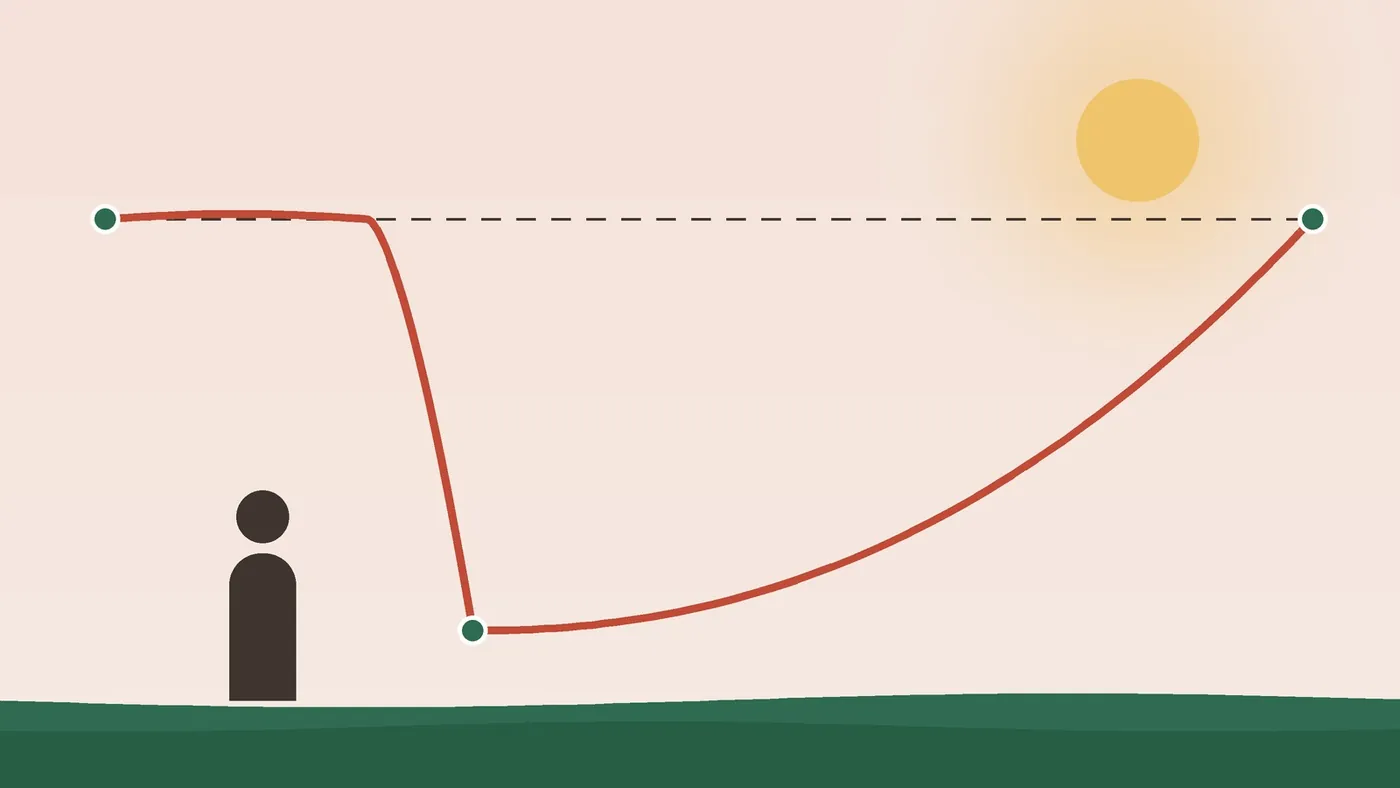
Here’s the part I’m not proud of. I’ve often passed that goal by September, stayed in the same names, taken nothing off the table, and then watched a good chunk of those unrealized gains evaporate.
Why? Three reasons, and they all come down to greed:
- I waited too long. The stock was working, so selling felt like quitting early.
- I hoped. I told myself it would keep rising, or at worst trade flat, while I decided what to do.
- I wanted to kick the tax can down the road. Selling makes the gain real, and a real gain comes with a tax bill. Not selling feels free. It isn’t.
An unrealized gain isn’t money you have. It’s a number on a screen that the market can take back whenever it likes, and it doesn’t owe you a warning. So I try to ring the register when either of two things happens.
Trigger one: the stock starts to stall
A stock rarely tells you it’s done, but it often stops acting like a winner. Good news no longer lifts it. Momentum fades. Readings like the Relative Strength Index look stretched. Everyone at the barbecue suddenly owns it. Any one of these can be noise. But when a big winner meets my stalling signals, my job is to stop arguing with them.
Trigger two: the whole portfolio has beaten my goal
This is the one that’s hardest to follow. If my entire portfolio is already past my goal for the year, what exactly am I still trying to prove? Enough should sometimes be exactly that. Hitting the goal is the moment to protect it, not a signal to press harder.
The tax excuse, in numbers
Let’s look at the excuse I use most. Say you put $100,000 into a stock and it grows to $150,000 after more than a year. To keep the math simple, assume a 15% federal long-term capital gains rate.
| What happens | Gain | Federal tax | You keep |
| Sell at $150,000 | $50,000 | $7,500 | $142,500 |
| Hold, it drops 15%, sell at $127,500 | $27,500 | $4,125 | $123,375 |
Waiting “saved” $3,375 in tax and cost $19,125 in money you keep. Of course, the stock might have kept climbing instead. That’s the risk you’re choosing between. The point is that a tax bill is a percentage of a gain, and you only owe it because you made money. Don’t let the smaller number make the decision for the bigger one.
It doesn’t have to be all or nothing
Ringing the register can mean selling everything or just trimming. Trimming pays you and leaves you some skin in the game if the stock keeps running. And yes, sometimes it will keep running after you sell. That stings. It’s also the price of never giving back everything. For more on this, read taking money off the table, and then the power of reusing capital for what to do with the proceeds.
2. Don’t Sit on a Loser Forever
I like to realize losses frequently, usually, but not always, at around 8% below what I paid.
Notice the hedges in that sentence. I don’t always follow my own advice. Sometimes I hold past that line and end up being right. Sometimes I hold and end up being very wrong. Sometimes I sell at minus 8% and the stock turns around the next week, just to annoy me. No surprise there. The market works in mysterious ways. And 8% is my number, not a law: on a volatile stock, that can just be a rough week.
The reason for having a line at all is simple. Without one, a small mistake gets the chance to become a big one, and “it’ll come back” is not a plan. I’ve written before about the asymmetry of loss: the deeper the hole, the harder the climb.
| If a stock falls | It needs this gain to get back to even |
| 8% | 8.7% |
| 20% | 25% |
| 30% | 42.9% |
| 50% | 100% |
An 8% loss is annoying. A 50% loss means you need to double your money just to get back to where you started. Selling early also frees up the capital and, just as important, the attention. Money stuck in a stock you no longer believe in can’t go to your next good idea.
There’s a tax benefit too. A realized loss can offset realized gains, so principle 2 helps pay for principle 1. Sell a $10,000 position at $9,200 and the $800 loss can cancel out $800 of gains. That’s worth $120 if those gains would be taxed at 15%, or $256 at 32%. It’s a consolation prize, not a reason to lose money, but I’ll take it.
FYI: how taxes on stock sales generally work
This is the general federal picture for U.S. investors in regular taxable brokerage accounts. Tax rules have exceptions, and your state may add its own tax.
| Short-term gain | Long-term gain | |
| Held for | One year or less | More than one year |
| Federal rate | Your ordinary income rate, up to 37% | 0%, 15% or 20%, depending on taxable income |
| 2026: single filers | Same as ordinary income | 0% up to $49,450, 15% up to $545,500, 20% above that |
| 2026: married filing jointly | Same as ordinary income | 0% up to $98,900, 15% up to $613,700, 20% above that |
A few things worth knowing, from the IRS and its 2026 inflation adjustments:
- Nothing is taxed until you sell. A gain is only “realized,” and taxable, when you actually sell. Dividends are taxed separately.
- Losses offset gains. Short-term losses first offset short-term gains and long-term losses first offset long-term gains. Then whatever’s left can offset the other kind.
- Extra losses carry over. If your losses exceed your gains, you can generally deduct up to $3,000 a year against other income ($1,500 if married filing separately). The rest carries forward to future years.
- Higher earners may owe more. The net investment income tax adds 3.8% above certain income levels, such as $200,000 for single filers and $250,000 for married couples filing jointly.
- Retirement accounts are different. Trades inside an IRA, Roth IRA or 401(k) don’t trigger capital gains tax each year, but losses inside them can’t offset your gains either.
Holding a winner a little longer to cross the one-year line can make sense when you’re close, because the rate difference can be large. Just remember that the stock doesn’t know your purchase date, and a falling price can erase the tax savings fast.
FYI: the wash sale rule
Things get complicated if you sell at a loss and want the same stock back. Under the wash sale rule, you can’t deduct the loss if you buy the same or a “substantially identical” stock within 30 days before or after the sale. That’s a 61-day window once you count the day of the sale.
The loss usually isn’t gone. It’s delayed. Here’s the IRS’s own example: you buy 100 shares for $1,000, sell them for $750, and buy them back within 30 days for $800. You can’t deduct the $250 loss now. Instead, it’s added to the cost of your new shares, making your cost $1,050, and you get the benefit when you eventually sell those.
The traps to watch for:
- It reaches across accounts. A purchase in another of your accounts can count, and so can one by your spouse or a corporation you control.
- Your IRA counts, and it’s worse there. If you sell at a loss and buy the same stock in your IRA or Roth IRA, it’s a wash sale, and the loss isn’t added to the cost of those shares. You can lose the benefit for good.
- Automatic purchases count. Reinvested dividends can trigger it. So can options to buy the same stock.
- It only applies to losses. Sell at a gain and buy back the next minute if you like. You’ll still owe tax on the gain.
The simple way around it is to wait 31 days before buying back, or to put the money into a different company in the meantime. A different company generally isn’t “substantially identical,” though for close look-alikes the answer depends on the facts. And if you’re active, keep your own records, because your broker’s tax form may not catch purchases made in other accounts.
3. Keep Asking “What’s Next?”
Selling only works if you have somewhere better to go. That’s where my “What’s Next” strategy comes in. Instead of chasing what’s already obvious, I keep asking what comes after it.
During the AI boom, that meant buying Nvidia (NVDA) when it was clear it had an edge in AI chips, then trimming when it felt like every investor on the planet was piling in. That sale raised the question again: what’s next? That’s how the thinking moved from chips to power to cooling. You can see how the idea plays out in the “What’s Next” in the AI gold rush.
Notice how this feeds principle 1. It’s much easier to ring the register when you’re excited about where the money is going next.
4. Think in Picks and Shovels
When a big idea takes hold, the obvious winners get crowded and expensive fast. The pick-and-shovel way of thinking looks at the ripple effect instead: which companies supply what the trend can’t function without, and often win no matter which brand comes out on top?
The goal is to go early to where people are going, not where they’ve already been. For a current example, see how power, permits and equipment are shaping the AI trade right now.
The Bottom Line
None of this is complicated. Take money when the market offers it. Cut small losses before they become big ones. Keep looking ahead. Look past the obvious. The hard part is doing it when a stock you love is up 60% and you’re sure it’s going higher, or down 8% and you’re sure it’s about to turn.
That’s why I set these principles down when I’m calm, so I can reread them when I’m not. Your numbers will be different from mine, and they should be. Pick your own goal and your own loss line. Just pick them before you need them.
Want to see how this plays out in real life, mistakes included? Our trades are updated hourly, and On Our Radar shows the stocks we’re looking at now.
This is what I try to do, not a recommendation for what you should do. Nothing here is investment or tax advice. Tax rules change and depend on your situation, so check with a tax professional before acting on them.
We don't currently earn commissions from links on this site. Nothing here is personalized investment advice; we are not licensed financial advisors. The authors may hold positions in securities we mention and may trade them at any time.