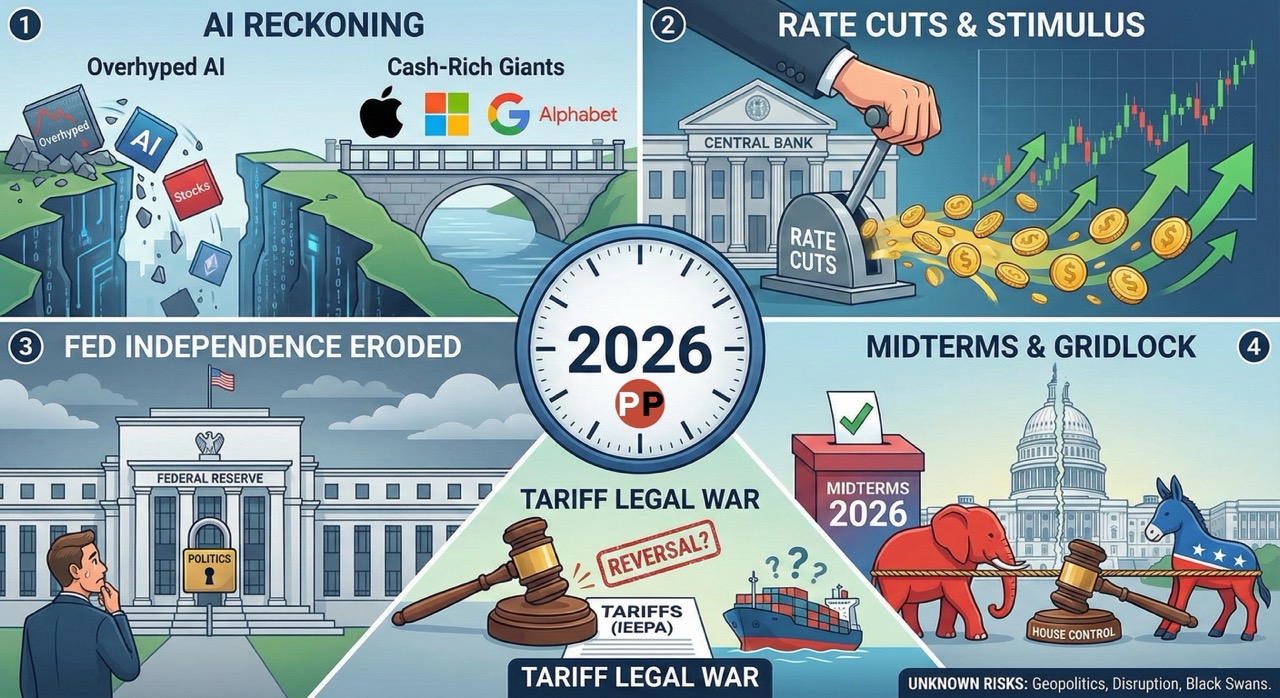
As we close the books on a volatile 2025, investors are looking toward 2026 with a mix of cautious optimism and acute anxiety. While the fundamental drivers of the market remain intact, the specific headwinds facing the coming year are distinct, complex, and potentially contradictory.
2026 promises to be a year defined by legal battles, monetary pivots, and the return of political gridlock. Here is an analysis of the five major “gotchas” that will define the investment landscape in 2026.

1. The AI Reckoning: From Hype to “Show Me the Money”
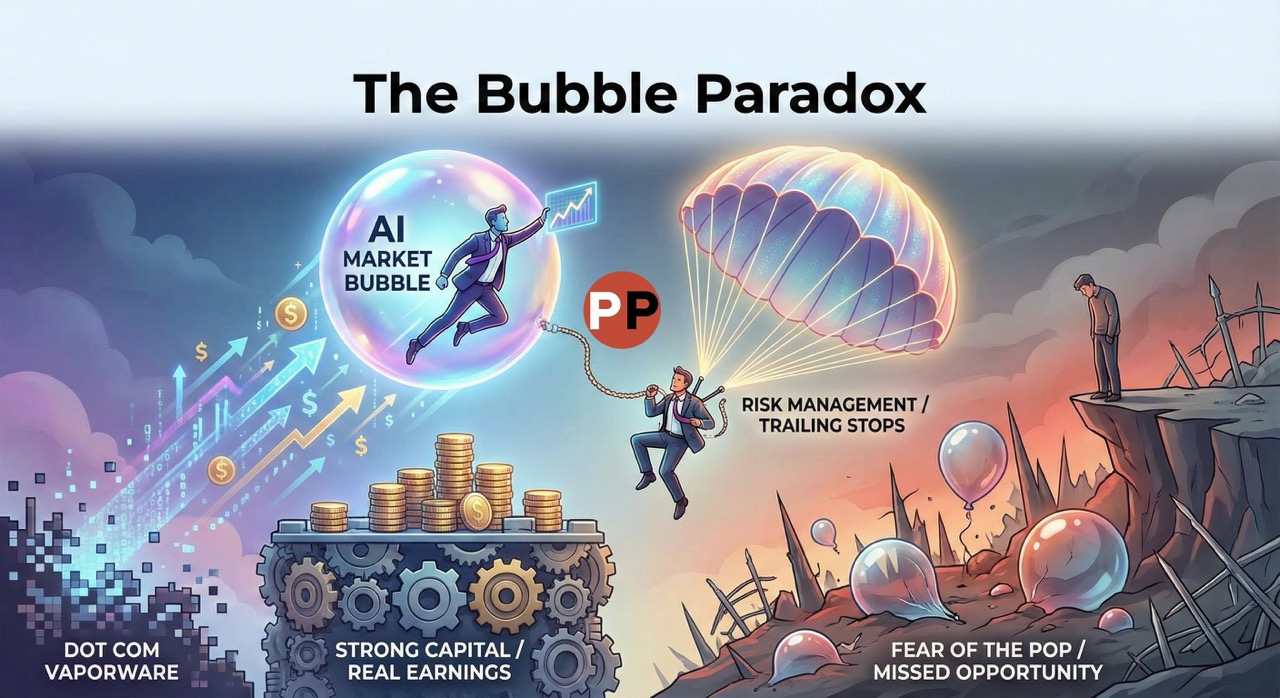
In 2025, we saw the initial cracks in the “AI at any cost” narrative. We witnessed high-flying startups with thin moats—those merely wrapping existing LLMs—plummet as the market realized they had no proprietary edge. However, the appetite for infrastructure and hardware remained voracious.
In 2026, we expect a revisiting of these valuation concerns, but with a sharper lens. The market is moving from the “installation phase” to the “deployment phase.” The “gotcha” here is that the market may punish companies that are still promising AI revolution without showing AI revenue.
- The Vulnerable: Overhyped mid-cap tech firms trading at 50x sales with no clear path to profitability will likely face a severe correction.
- The Resilient: Conversely, this valuation scrutiny will likely be a non-event for the “Mag 7” and other cash-rich giants. Companies sitting on massive piles of cash (Apple, Microsoft, Alphabet) have the liquidity to pivot, acquire distressed competitors, and weather a sentiment shift. For them, a dip is a buying opportunity; for the speculative players, it could be an existential crisis.
2. The Rate Cut “Sugar High”
After a prolonged period of elevated borrowing costs, the consensus is that 2026 will be the year of substantial rate cuts.
- The Stimulus Effect: Lower rates are the classic fuel for a bull market. As the cost of capital decreases, corporate borrowing becomes cheaper, fueling expansion and stock buybacks. Furthermore, as yields on Treasuries and savings accounts drop, capital is forced back into equities in search of returns (the TINA effect—There Is No Alternative).
- The Gotcha: The danger lies in why the rates are being cut. If rates are cut because inflation is tamed, the market will soar. If rates are cut frantically because the economy is entering a recession, the stock market stimulus may be overshadowed by falling corporate earnings.
3. The Erosion of Fed Independence
Perhaps the most structural risk in 2026 is the growing perception of a lack of Federal Reserve independence. While investors generally love rate cuts, they may not like the reasoning behind them if they suspect the Fed is bowing to Administration pressure rather than economic data.
- The Trust Deficit: The independence of the Fed is a cornerstone of the global financial system. It ensures that monetary policy is used to stabilize the currency, not to boost poll numbers.
- Market Reaction: If the market senses the Fed is fully controlled by the White House, we could see a “tantrum” in the bond market and volatility in equities. It is unclear if this will become a systemic crisis—where foreign investors dump US debt due to a loss of faith in the Dollar—or if it will be a temporary concern where investors eventually grow “numb” to the politicization, accepting it as the new normal so long as the liquidity taps remain open.
4. The Midterm Election Cycle and the “Flip”
2026 is a midterm election year, and history provides a specific roadmap for these cycles.
- Historical Context: Historically, the first two or three quarters of a midterm year are marked by high volatility and sideways movement as the market digests political uncertainty. However, Q4 of midterm years—once the results are known—often kicks off a powerful rally.
- The Washington Flip: Current polling suggests a strong possibility of the House flipping from Republican to Democratic control.
- The Gridlock Thesis: Conventional wisdom says markets love gridlock because it prevents radical legislation (and new taxes) from passing. However, the “gotcha” in 2026 is that gridlock might look more like paralysis. If a Democratic House clashes with the Administration on the debt ceiling or the budget, we could face government shutdowns. While “paralysis” usually implies safety for stocks, dysfunction regarding the nation’s credit rating is a different beast entirely.
5. The Tariff Legal War: IEEPA vs. Congress
A major storm cloud for 2026 involves the Supreme Court ruling on the legality of the Administration’s aggressive use of tariffs. These levies were implemented using the International Emergency Economic Powers Act (IEEPA), bypassing Congress, which traditionally holds the “power of the purse” regarding taxation and trade.
- Reversal of Tariffs: If the Supreme Court rules against the Administration, tariffs could be wiped out overnight. On paper, this is bullish—it lowers costs for importers and reduces inflation for consumers.
- The Uncertainty Shock: However, the market hates chaos more than it hates taxes. A sudden reversal introduces massive regulatory uncertainty. Companies have built supply chains based on current tariff regimes.
- Flashback to April 2025: Investors remember the carnage of April 2025, when tariff rhetoric first spiked, causing immediate repricing of risk assets. A sudden judicial voiding of trade policy could re-introduce that high-level volatility. The “reversal of the reversal” creates a chaotic environment where corporations cannot plan more than a few months ahead, usually leading to a freeze in capital expenditure.
Conclusion
As we head into 2026, the savvy investor must look beyond simple P/E ratios. The year will be defined by a tug-of-war between the stimulus of lower rates and the structural anxieties of Fed politicization, election-year gridlock, and Supreme Court intervention in trade policy.
While these five points represent the “known unknowns,” investors must remain humble. If history has taught us anything, it is that the biggest shock of 2026 will likely be something that isn’t on this list at all—a geopolitical event, a natural disaster, or a technological disruption that we cannot yet conceive. Adaptability, as always, will be the only true hedge.