If you’ve turned on financial news lately, you’ve likely heard the eulogies for the software industry. The narrative is breathless and confident: Artificial Intelligence is coming for Software-as-a-Service (SaaS). We are told that “vibe coding”—the ability for non-technical users to simply prompt an AI to “build me an app”—will render multi-billion dollar enterprise platforms obsolete. The logic goes that if anyone can whip up a bespoke CRM, IT, or HR tool in an afternoon using ChatGPT or Claude, why would any company pay millions to Salesforce, ServiceNow, or Workday?
I’ve watched dozens of these so-called experts push this theory. They correctly identify that AI is democratizing development, allowing people to build impressive, functional applications just by describing what they want.

But here is where they get it wrong: They are confusing the act of generating code with the reality of managing enterprise architecture.
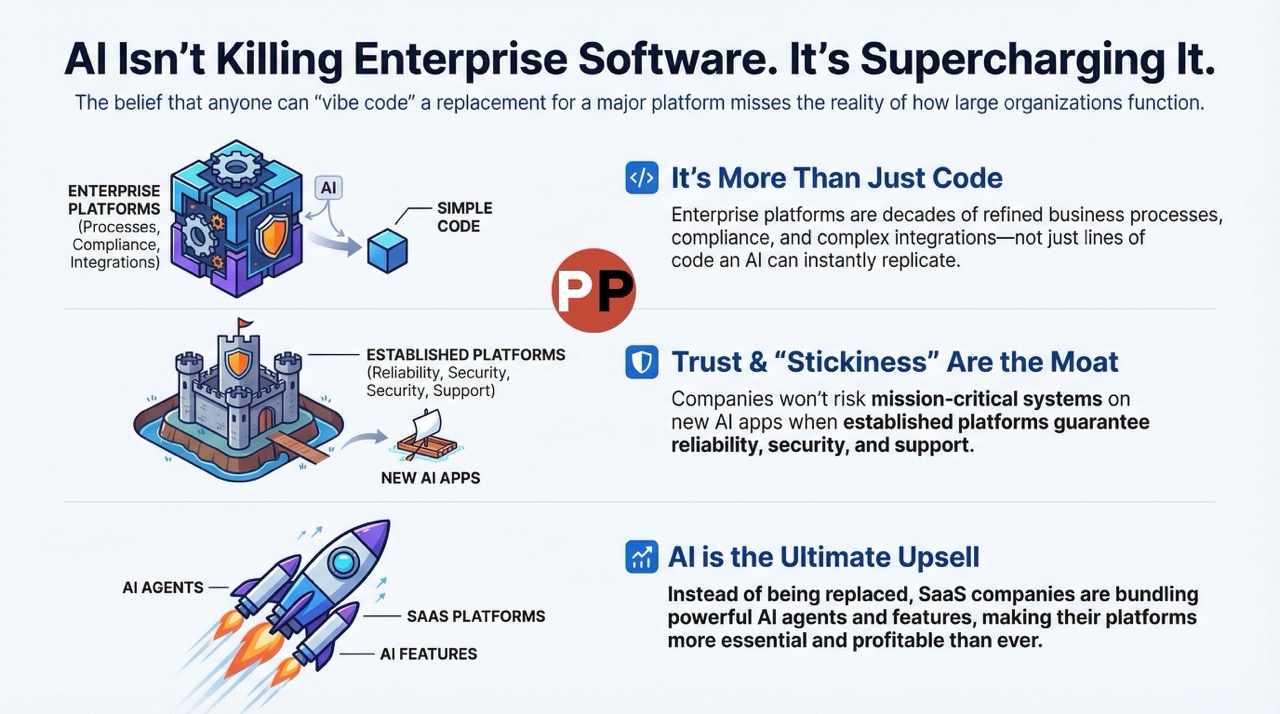
These pundits are often generalists. They likely haven’t managed a complex IT stack, navigated a SOC2 compliance audit, worked hard to maintain best practices and regulatory compliance, or overseen a migration of a mission-critical ERP system. While vibe coding is a breakthrough that will undeniably solve thousands of business problems, the idea that it will replace major enterprise platforms is a fundamental misunderstanding of how large organizations function.
The reality is the opposite: AI is not the asteroid coming to kill SaaS; it is the rocket fuel that will make these platforms stickier, more profitable, and more essential than ever.
Here is the reality behind the misconception.
1. The “Stickiness” Factor: You Don’t Just “Vibe” Your Way Out of a Contract
Enterprise software is famously sticky. Once a system is deployed, displacing it is an act of corporate surgery. It is expensive, risky, and time-consuming.
Pundits imagine that because an AI can write code, a CIO will wake up one morning and decide to replace a battle-tested platform with a home-brewed AI app. In the real world, no executive is going to bet their career on a custom-generated application to manage their global supply chain or financial records unless it is proven to be bulletproof. Organizations need certainty. They need SLAs (Service Level Agreements), support structures, and guaranteed uptime. Vibe coding is incredible for agility and internal tools, but it faces a massive hurdle of trust in production environments where a single bug can cost millions.
2. It’s Not Just Code; It’s Process
The biggest error the “death of software” crowd makes is assuming software is just a collection of code. In the enterprise, software is a System of Record and a System of Action.
When you buy a platform like Salesforce, Service Now, or Workday, you aren’t just buying code; you are buying decades of industry best practices crystallized into workflows. You are buying the “Ironed-out” processes for CRM, IT Service Management, and HR that have been optimized over thousands of implementations. These systems handle complex permissions, audit trails, and regulatory requirements out of the box. You cannot simply prompt an AI to instantly replicate twenty years of process optimization and regulatory compliance logic without eventually rebuilding the very complexities you tried to avoid. You would need an army of developers and testers to maintain that level of complexity and customization.
3. The Integration Spiderweb
Enterprise systems do not live on islands; they live in a dense web of integrations. Your ITSM platform talks to your HR system, which talks to payroll, which connects to procurement.
These integrations are sophisticated, fragile, and vital. Replacing a major software platform isn’t just about swapping out one app; it’s about untangling a nervous system. While AI might help you build a robust point solution, it is currently nowhere near capable of replacing the end-to-end platform integrations that power the modern enterprise. The “moat” here isn’t just the code; it’s the connectivity.
4. It’s Not a Zero-Sum Game (The “And” Argument)
The bearish thesis assumes that AI and SaaS are enemies. In reality, they are partners. The existence of powerful AI models doesn’t mean you stop using SaaS; it means you use AI on top of your SaaS.
We are already seeing a hybrid model emerge where the “system of record” (the SaaS platform) provides the trusted data, and the AI acts as the reasoning engine on top of it. Enterprises want the best of both worlds: the flexibility of AI to build custom extensions and the stability of a managed platform to run the core business. They will build with AI, but they will deploy on the platform.
5. The Double-Dip: Innovation Speed and New Revenue
Far from being victims, major software companies are the biggest beneficiaries of the AI boom. This is happening in three distinct ways:
- Internal Velocity: SaaS companies are using AI to accelerate their own R&D. They are fixing bugs faster and shipping features cheaper.
- The AI Premium: Companies are successfully bundling AI features into new, higher-priced SKUs. It is the perfect upsell: “Want the AI agent that automatically resolves 30% of your tickets? Upgrade to the Pro tier.”
- Agentic Workflows: Look at ServiceNow and Salesforce. They aren’t waiting to be disrupted; they are becoming the disruption.
- ServiceNow is deploying AI agents that don’t just “chat” but actively resolve IT incidents, analyzing logs and executing fixes within the platform’s secure boundary.
- Salesforce has pivoted massively to “Agentforce,” allowing customers to deploy autonomous agents that act within the CRM.
Because these agents live inside the platform, they have access to the structured data and context that a generic AI model simply doesn’t have. This makes the platform infinitely more valuable—and stickier—than before.
The Bottom Line
The argument here is that while the market punishes software stocks for a perceived threat, the underlying companies are becoming stronger. AI helps SaaS companies save money on development while simultaneously giving them a new, high-margin product to sell.
We are not witnessing the death of enterprise software. We are witnessing its evolution into something more intelligent, more automated, and inevitably, more expensive. Vibe coding will unlock massive creativity and solve countless problems, but the enterprises will continue to rely on the platforms that run the world to handle their most critical operations.