If you’ve been watching the headlines since the weekend, you know the world changed on January 3rd. The execution of Operation Absolute Resolve—the U.S. military operation that resulted in the capture of President Nicolás Maduro and Cilia Flores—sent shockwaves through geopolitical circles. But as always, the financial markets didn’t wait for the dust to settle before placing their bets.
The immediate reaction on Wall Street was a textbook knee-jerk play: Buy Oil.
Speculation ran wild on Monday morning. The logic seemed simple enough to the average retail investor: Conflict in a major oil-rich nation equals volatility, which historically triggers a rush into energy names. We saw a massive initial “pop” across the board. The heavyweights—Exxon Mobil (XOM) and Chevron (CVX)—jumped right alongside the oilfield service giants, Schlumberger (SLB) and Halliburton (HAL).
But as we sit here on January 6th, just a few days later, the charts tell two very different stories. If you bought “oil” blindly, you might be scratching your head. If you bought “infrastructure,” you’re likely still holding gains.
Here is why the market bifurcated so quickly, and why nuance is the most profitable asset in a crisis.

The Producers vs. The Builders
To understand the price action from Jan 2nd to today, you have to understand the fundamental difference in how these companies make money in a post-Maduro Venezuela.
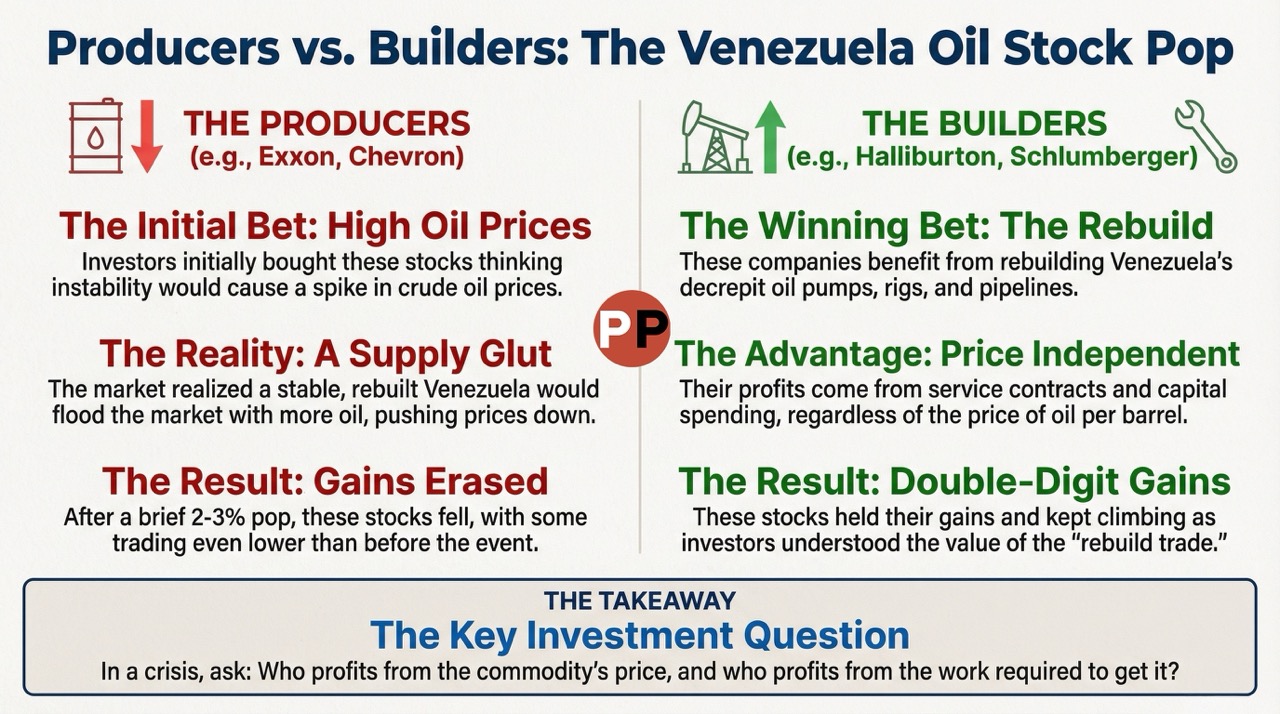
The Producers: XOM and CVX Investors initially bid up Exxon and Chevron thinking that instability would spike crude prices. However, the reality of the situation set in within 48 hours. A U.S.-backed change in regime suggests the eventual lifting of sanctions and the modernization of Venezuela’s oil output.
The market quickly realized that “success” in Venezuela doesn’t mean $150 oil; it potentially means more supply flooding an already oversupplied global market. As news cycles turned to the stabilization of the region, the fear premium evaporated. The gains XOM and CVX saw on January 3rd have largely vanished as traders priced in the bearish reality of a supply glut.
The Builders: SLB and HAL Contrast that with Schlumberger and Halliburton. These stocks popped on the news and sustained those gains. Why?
Because Venezuela’s oil infrastructure is in ruins. Decades of mismanagement mean that the pumps, rigs, and pipelines are decrepit. Regardless of whether oil is $60 or $90 a barrel, if Venezuela wants to pump it, they need to rebuild the physical hardware first.
That is where SLB and HAL come in. They are the beneficiaries of the effort to extract oil, not just the price of the commodity itself. The “rebuild trade” is robust because it relies on contracts and capex spending that will happen even in a lower-price environment. The market correctly identified that these companies will be printing invoices to clean up the mess and get the oil flowing again.
| Stock | Company Type | Jan 2 Close (Pre-Attack) | Jan 5 Open (The “Pop”) | Jan 6 Close (Current) | Net Change (Jan 2 – Jan 6) | Status |
| XOM | Producer | $122.65 | $125.50 | $121.05 | -1.30% | Gains Vanished |
| CVX | Producer | $152.10 | $156.40 | $152.25 | +0.10% | Flat |
| SLB | Builder/Service | $40.10 | $43.00 | $43.63 | +8.80% | Sustained |
| HAL | Builder/Service | $28.20 | $31.50 | $31.92 | +13.19% | Sustained |

My Take
I didn’t take advantage of this opportunity myself. As regular readers and followers of my trades know, I’m nearly fully invested right now, and I didn’t have the appetite to dump my existing high-conviction positions to chase a geopolitical event, especially one this volatile.
However, the lesson here is valuable even if, like me, you stayed on the sidelines. It is a reminder that “Sector Investing” is often too broad. Lumping producers and service companies into the same “Oil Trade” bucket would have left you breaking even on the producers, while missing the distinct alpha generated by the service companies.
In the future, when looking at distressed nations and regime changes, ask yourself: Who benefits from the price of the commodity, and who benefits from the work required to get it? In 2026, the money is clearly on the work.