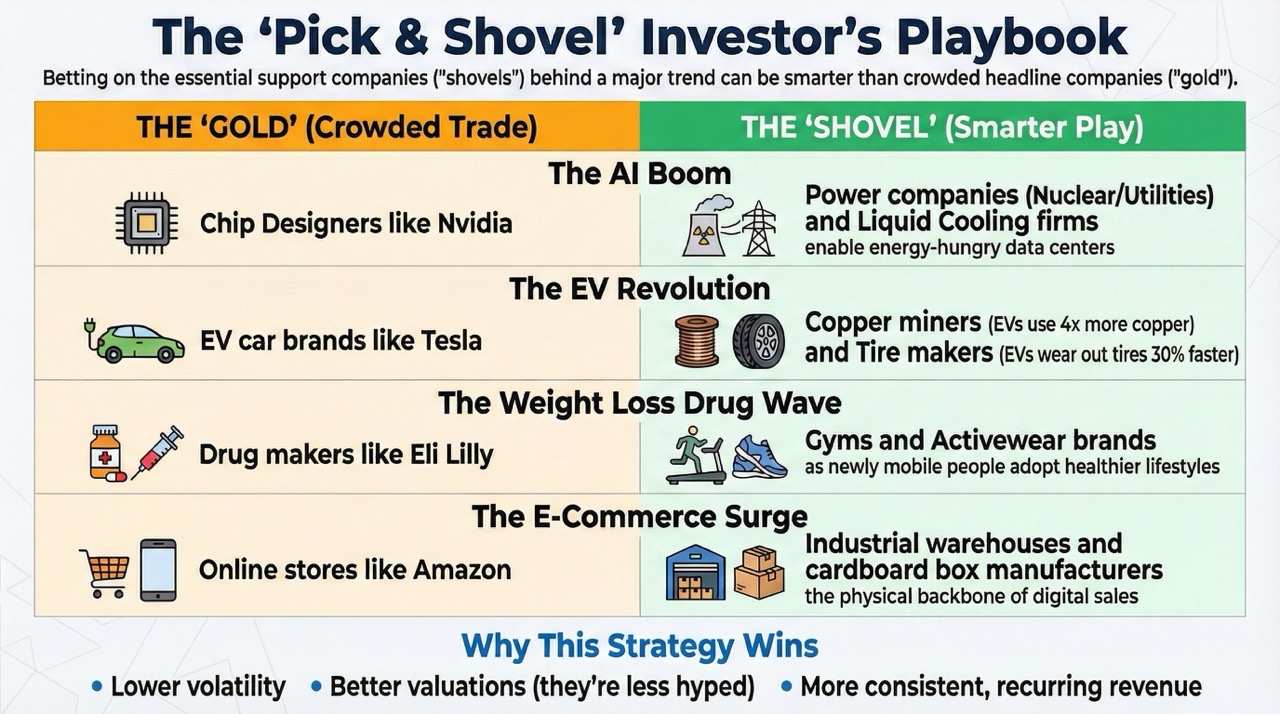
The AI revolution is in full swing, and if you’ve been in the market for the last few years, you’ve likely seen incredible gains in companies like Nvidia, Microsoft, and Amazon. The “AI trade” has undeniably become crowded, with a lot of froth around the big-name players and well-established trends.
But for those of us who like to look ahead, the real question isn’t “what’s now,” but “what’s next?”
My investment strategy, which I call the “What’s Next” thesis, is about identifying the emerging bottlenecks and indispensable components of the AI infrastructure before they become mainstream. It’s about following the technology’s supply chain to its logical next choke point.
Here’s how I’ve approached it:
- Initially, I looked at AI software itself.
- Then, I saw the need for computational power and invested in GPU companies like Nvidia.
- As data centers grew, the critical need for power became clear, leading to investments in utilities serving these hubs.
- Next, the immense heat generated by these powerful chips pointed to data center cooling solutions.
This approach has yielded significant returns by anticipating the next essential layer of the AI stack. So, with the current AI market feeling crowded, where do we look now?
Based on current industry trends and emerging challenges, I believe the next major opportunities lie in three critical areas: The Nervous System, The Manufacturing Wall, and The Decentralization Era.
Let’s dive in.
1. The “Nervous System”: Interconnects, Optics, & Custom Silicon
The Bottleneck: We’ve built massive data centers filled with GPUs, powered and cooled effectively. But how do you get thousands of these powerful chips to communicate with each other at speeds necessary for complex AI models? Standard networking simply isn’t fast enough. The new bottleneck is data movement – the “nervous system” that allows a colossal AI supercomputer to function as one cohesive brain.
This has created a surge in demand for hyper-fast interconnects, optical components that transmit data using light, and specialized silicon designed to enable this high-speed communication within custom AI chips.
Stocks to Watch:
- ANET (Arista Networks): A leader in high-speed data center switches, enabling the shift to Ethernet-based AI networks, which are becoming a critical alternative to proprietary interconnects.
- AVGO (Broadcom): A dominant player in networking chips and a crucial enabler for “custom silicon.” Hyperscalers are designing their own AI chips (ASICs), and Broadcom provides the essential high-speed communication intellectual property (IP) needed to make them work.
- MRVL (Marvell Technology): A key player in data infrastructure, providing critical optical components for the fastest data rates (800G/1.6T) and crucial IP for custom AI accelerator chip designs.
- COHR (Coherent) & LITE (Lumentum): These companies are the “picks and shovels” of the optical world, manufacturing the high-speed optical transceivers and lasers essential for moving vast amounts of data within and between data centers.
- CRDO (Credo Technology): Specializes in Active Electrical Cables (AECs) and other interconnects, which are vital for the ultra-high-speed, low-power connections required inside server racks, linking GPUs together.
2. The “Manufacturing Wall”: HBM & Advanced Packaging
The Bottleneck: We have the designs for incredible AI chips, but physically building them at scale is proving to be a monumental challenge. The “manufacturing wall” refers to the scarce, specialized components and the incredibly complex machinery required to produce the most advanced AI accelerators. Nvidia doesn’t magically produce its chips; it relies on a sophisticated and strained global supply chain.
Specifically, two components are non-negotiable for cutting-edge AI accelerators: High-Bandwidth Memory (HBM) and the advanced packaging equipment needed to assemble these complex “chiplets.”
Stocks to Watch:
- MU (Micron Technology): One of only three companies globally that produces HBM, the ultra-fast, stacked memory that is indispensable for AI GPUs. Micron’s HBM3E is a key component in Nvidia’s latest accelerators.
- ASML (ASML Holding): A near-monopoly. ASML manufactures the incredibly complex EUV (Extreme Ultraviolet) lithography machines that are absolutely essential for producing all advanced AI chips from leading foundries like TSMC.
- LRCX (Lam Research): A crucial “picks and shovels” provider. Its equipment is vital for etching and depositing materials during the manufacturing process of advanced chips, including the critical steps for HBM and advanced packaging.
3. The “Decentralization Era”: Edge & On-Device AI
The Bottleneck: So far, the AI revolution has been dominated by massive, centralized data centers that train enormous AI models in the cloud. But sending every single AI query (from your phone, your car, or a factory robot) back to a distant data center is too slow, too expensive, and often too power-intensive. The “Decentralization Era” focuses on inference – running smaller, hyper-efficient AI models directly “at the edge” (on the device itself).
This requires a completely different class of specialized, low-power AI chips and software that can deliver intelligent capabilities without relying on constant cloud connectivity.
Stocks to Watch:
- QCOM (Qualcomm): A dominant leader in mobile chips. Its Snapdragon processors, with integrated Neural Processing Units (NPUs), are powering the emerging “AI smartphone” and “AI PC” categories, bringing AI directly to consumers.
- ARM (Arm Holdings): Arm’s processor architectures are the foundation for nearly every smartphone and countless edge devices. Its intellectual property is critical for designing the low-power, efficient NPUs that enable AI to run directly on devices.
- NXPI (NXP Semiconductors): A leader in automotive and industrial microcontrollers. NXP is embedding AI capabilities into chips for connected cars, factory automation, and secure edge computing devices.
- LSCC (Lattice Semiconductor): A pure-play on edge AI, Lattice creates small, low-power, and programmable chips (FPGAs) specifically designed for AI tasks like computer vision and predictive maintenance in industrial and robotic applications.
- AMBA (Ambarella): Specializes in AI-powered computer vision chips. Its technology is crucial for AI-enabled security cameras, advanced driver-assistance systems (ADAS), and various robotics applications.
The Road Ahead
The AI landscape is constantly evolving, and staying ahead means understanding where the next bottlenecks and innovations will emerge. While the current “AI trade” might feel saturated, by looking beyond the obvious and focusing on these underlying critical components and architectural shifts, investors can position themselves for the next wave of growth.
The “Nervous System”: Interconnects, Optics, & Custom Silicon
| Symbol | Name | Price | 52 Week Low | 52 Week High | Diff From High |
| ANET | Arista Networks Inc | $134.93 | $59.43 | $164.94 | 22.24% |
| AVGO | Broadcom Inc | $351.96 | $138.10 | $386.48 | 9.81% |
| MRVL | Marvell Technology Inc | $89.33 | $47.09 | $127.48 | 42.71% |
| COHR | Coherent Corp | $158.01 | $45.58 | $168.57 | 6.68% |
| LITE | Lumentum Holdings Inc | $252.47 | $45.66 | $273.89 | 8.48% |
| CRDO | Credo Technology Group Holding Ltd | $158.50 | $29.09 | $193.50 | 22.08% |
The “Manufacturing Wall”: HBM & Advanced Packaging
| Symbol | Name | Price | 52 Week Low | 52 Week High | Diff From High |
| MU | Micron Technology Inc | $244.90 | $61.54 | $257.07 | 4.97% |
| ASML | ASML Holding NV | $1,037.33 | $578.51 | $1,086.11 | 4.70% |
| LRCX | Lam Research Corp | $161.42 | $56.32 | $167.13 | 3.54% |
The “Decentralization” Era: Edge & On-Device AI
| Symbol | Name | Price | 52 Week Low | 52 Week High | Diff From High |
| QCOM | Qualcomm Inc | $173.98 | $120.80 | $205.55 | 18.15% |
| NXPI | NXP Semiconductors NV | $202.86 | $148.09 | $255.41 | 25.90% |
| LSCC | Lattice Semiconductor Corp | $66.06 | $34.69 | $76.61 | 15.97% |
| AMBA | Ambarella Inc | $93.53 | $38.90 | $95.72 | 2.34% |